You are here: Home » Issue 3

Issue 3

List of everything in this issue
  1. Article "Archaeology is not an exact Science": The approaches and methods of two 1930s Archaeologists: Rene Belloq and Dr Henry Jones Jr. (Part One)
    As Archaeology blossomed into the discipline we know today there emerged several notable figures, each making significant advances in archaeological method in their own particular style. These were men like Mortimer Wheeler and Augustus Pitt Rivers (Lieutenant-General Augustus Henry Lane...
  2. Article Interview with an Archaeologist - Pete Smith, English Heritage.
    What is your job title? Senior Architectural Investigator, within Research and Standards, prior to this I was an Historic Buildings Inspector and Team Leader in the Listing Branch (HPR). What are you current projects? Apethorpe Hall, Northamptonshire: Chapter for the fo...
  3. Article Review: The Architect is Not a Carpenter: On Design and Building, a talk by Tim Ingold
    Professor Ingold, University of Aberdeen, gave a lecture with the above title to a collection of students and staff at the University of York on the 14th January 2009, summarising the second of three chapters of his book which is soon to be published - The Four As: Anthropology, Archae...
  4. Article Why Study the Present?
    There is a challenge issued in "The History Boys" by the morally ambivalent Irwin as he leads his students through a discussion of the holocaust: Our perspective on the past alters. Looking back, immediately in front of us is dead ground. We don't see it, and because we don't...
  5. Article Hints and Tips: Volunteering
    By now I'm guessing you have all been badgered about getting experience and becoming a "well rounded individual"; whether you're a first, second or third year, experience is always useful to have. The easiest way to get experience is by volunteering. Many people associate volu...
  6. Article Ancient Science: The Antikythera Mechanism
    The Antikythera Mechanism has been a source of intrigue and amazement since the main fragment was discovered by Valerios Stais in 1902. It was found in the wreck of a Roman merchant ship off the coast of Antikythera where it had lain since between 85 and 60BC. The wreck had been discovere...
  7. Articles Read the whole of issue 3 online
    Ideal if you want to skim over everything quickly,
  8. Adobe PDF Issue 3 (PDF)
    Download the whole of issue 3 in PDF format. You can read this offline and it is optimised for printing.

Get Adobe Reader The list above contains links to all individual articles in this issue and the option to download it as a PDF. Most computers will already be able to open PDF files but if you can't you'll need to download a copy of Adobe Reader by clicking on the logo to the right.

"Archaeology is not an exact Science": The approaches and methods of two 1930s Archaeologists: Rene Belloq and Dr Henry Jones Jr. (Part One)

David Rounce
David Rounce

As Archaeology blossomed into the discipline we know today there emerged several notable figures, each making significant advances in archaeological method in their own particular style. These were men like Mortimer Wheeler and Augustus Pitt Rivers (Lieutenant-General Augustus Henry Lane Fox Pitt Rivers, as he was known to his friends) who, had it existed, would have both rightly assumed places in the Archaeologist’s hall of fame. Unfortunately History has tended to ignore a further two figures, both accomplished archaeologists in their own right, who were active in the first part of the last century, particularly the 1930s. The men in question are Dr Henry 'Indiana' Jones Jr, a professor at Marshall College, Bedford, Connecticut, and Rene Belloq, who was French.

The article, both in this issue and the next, attempts to shed some light on these men and the research they undertook. I have singled out two projects from 1936 which are notable because both Dr Jones and Belloq worked on them and, as we shall see, their drastically varying approaches and methods had the potential to become a source of tension.

1936: Hovitos Temple, Peru: The 'Golden Idol'

At this site both archaeologists worked, with varying degrees of success, to research a Chachapoyan temple containing a golden representation of their Goddess of fertility. Dr Jones, characteristically eager to begin fieldwork, ventured into the Peruvian jungle with a small party of guides and helpers. Unfortunately his team, which had admittedly been chosen poorly, proved less than satisfactory after one member tried to shoot him, and the rest ran away. Belloq, on the other hand, showed he was far ahead of contemporary archaeological practice by involving the native Hovitos population from an early stage, presumably with a presentation in the local village hall outlining his project and how it would benefit the community. The courtesy shown to the indigenous population was sufficient to earn Belloq the full co-operation of the Hovitos, and in a heart-warming gesture they pledged to kill anyone attempting to disrupt the work.

Dr Jones, followed by Satipo, the sole remaining loyal member of his group, successfully located the entrance to the temple using one of the most advanced pieces of technology available to archaeologists of the time: an old map. Having found the fertility idol in its original resting place inside the temple, Dr Jones, with no effort made to photograph, measure, or otherwise record its interior, attempted to purchase the idol from the Gods with sand. Here his preliminary research let him down as Dr Jones was ignorant of the fact that sand was not the currency in Peru at the time, indeed had not been for several years. As a result the Gods became angry and smited the temple, causing it to collapse into a pile of rubble, including oddly spherical boulders, thus destroying any opportunity for a further, more thorough study of its remains. An unfortunate casualty in the destruction of the temple was the loyal Satipo who, having grown disillusioned with Dr Jones’ cavalier approach to artefact retrieval, had attempted to remove the idol himself in order to ensure its proper treatment.

The sole survivor of his expedition, Dr Jones was forced to donate the idol to the Hovitos, via Belloq, who concluded the handover ceremony with his trademark evil chuckle. Having angered the native population by desecrating their cultural heritage, he escaped in the aeroplane which is speculated to have been employed in the pre-excavation stages to conduct an aerial photographic survey.

So what conclusions can we draw from this project? Well, at this stage it seems obvious that Dr Jones’ strengths lay in fieldwork, but his preparation and organisational skills were certainly deficient, as was his lack of awareness of the wider cultural issues, all of which tend to reduce the quality of his research, as well as any potential future publication of his findings. Rene Belloq, on the other hand, although not as actively involved in the practical side of the research, proved adept at getting the Hovitos on his side and employing them in the project, exhibiting a sensitivity to the concerns of the local population sadly lacking in Dr Jones’ expedition. As Belloq observed to Dr Jones at the conclusion of the project; 'If only you spoke Hovito'.

In the next issue we will explore how Dr Jones and Belloq approached their next project, a large scale dig in Egypt at Tanis, near Cairo.

Interview with an Archaeologist - Pete Smith, English Heritage.

Katie Marsden
Katie Marsden
  1. What is your job title?
    Senior Architectural Investigator, within Research and Standards, prior to this I was an Historic Buildings Inspector and Team Leader in the Listing Branch (HPR).
  2. What are you current projects?
    Apethorpe Hall, Northamptonshire: Chapter for the forthcoming book – Audley End Stables, Essex: Historic building report – Nottingham City, Characterisation report.
  3. What first got you interested in Archaeology?
    I first became interested in Architectural History through my Art Master at School – J B Nellist.
  4. How did you get into the Archaeology careers field and your current job?
    I took a degree in Art History and Architectural History at Reading University. At that time it was impossible to study Architectural History as a single subject, and the course at Reading under Professor Kerry Downes was the nearest I could get.
    Whilst doing my PhD I attended a Conference about the English Country House where I heard about the job that I eventually applied for, and got, working on the Accelerated Resurvey of Historic Buildings at the Department of the Environment – eventually English Heritage.
  5. What kinds of experiences have got you where you are today?
    Keeping my eyes open. Being open to new ideas and resources. Asking colleagues for advice. Attending conferences; giving papers and generally getting involved with relevant societies. Networking. Continuing my own personal research.
  6. What are some of the best parts of your job?
    Research and the opportunity to visit buildings and investigate them.
  7. And some of the worst?
    Writing up reports – applying for permissions to use photographs etc..
  8. How much do you have to deal with members of the public?
    Not much in my present job, but in my previous job as a Listing Inspector we had to deal with the public and the consequences of public queries and requests all the time.
  9. What are your thoughts on the state of the buildings archaeology? Do you think it is adequate, is there any room for improvement and if so where?
    There are two separate disciplines vying for control of the study of buildings; Archaeology and Architectural History. Both have interesting and very different contributions to make to the study of buildings and it is high time that these differences were amalgamated together into courses for students, rather than perpetuating this ridiculous false rivalry.
  10. How do you see the current Archaeological climate in terms of jobs in this country?
    Not very bright at the moment. The financial downturn especially in the property market is bound to decrease the amount of work available right across the architecture/development/planning industries.
  11. What advice do you have for students wishing to get a job in Archaeology or Buildings Archaeology?
    Specialise and yet be prepared to take on any work; one can never tell what you might learn from an individual job or project. For example: I personally never had much interest in vernacular architecture, but as part of my 'listing work' I had to become familiar with this architectural subject and it taught me a huge amount about how to assess buildings without any documentary evidence and it educated my eyes to notice every detail of a building.
  12. What are your experiences of job interviews?
    I have more experience of interviewing than being interviewed. Fill in the form accurately and include all your experience and knowledge, you never know what they are looking for.
  13. Do you have any interview technique tips?
    • Listen to the questions that you are asked! And think before you answer!
    • Try and bring your experience into your answers and give examples.
    • Stick to what you really understand, talking about subjects you don’t really understand will only show up your ignorance. Be prepared to admit that you don’t have experience of certain subjects – though you can still try to explain how you would go about gaining the necessary experience or how you would apply the knowledge you do have to the subject.
    • Field tests. Do some homework, read Pevsner, any RCHME volumes or local studies.
    • Most important; explain how you come to the conclusions and answers that you give - interviewers are as interested in your thought processes as in what you actually know.

With thanks to Katie Graham and Pete Smith of English Heritage, Cambridge.

Review: The Architect is Not a Carpenter: On Design and Building, a talk by Tim Ingold

Gemma Doherty
Gemma Doherty

Professor Ingold, University of Aberdeen, gave a lecture with the above title to a collection of students and staff at the University of York on the 14th January 2009, summarising the second of three chapters of his book which is soon to be published - The Four As: Anthropology, Archaeology, Art and Architecture. The main focus of the lecture was to question the dominance of Aristotle's hylomorphic theory in relation to late and post-medieval architecture. Hylomorphism in relation to architecture is a common theory held by many art and architectural historians, which emphasises the division of "design" from "material". In such a way the design of a structure is held up to be the perfect, unerring ideal with the material realisation of such a design being purely a crystallisation of the design components. This emphasises the role of the architect, as purported by the Italian architect Leon Battista Alberti in his De Re Aedificatoria. At the same time this theory downplays the role of the highly skilled craftsmen, in particular the master masons. This theory underlies a dominant assumption: that a building had a finished state, as dictated by the architect's design. It is this assumption that Professor Ingold challenges; presenting a building as a process rather than an object; a process which continues from the initial conception phase throughout its existence via construction and occupation.

Professor Ingold's lecture highlighted the need for the role of the architect in comparison to master masons and craftsmen to be carefully considered and the common hylomorphic assumptions questioned. However, his own challenge to these assumptions was highly theoretical and would have gained more credibility and support if specific sites were used to support his arguments. A highly literary focus ran throughout his presentation, with more time spent on the historical definitions of the word 'architect' than on examples where alternative approaches to late and post-medieval architecture were carried out. The main case study highlighted was David Turnbull's work at Chartres Cathedral, which compares the building of Chartres Cathedral with the workings of a research laboratory; small, autonomous units working independently, while communicating with each other.

Overall, this lecture was highly interesting and challenged buildings archaeologists and architectural historians to reassess some of their key assumptions. Introducing ideas, but not truly examining how these have been used to approach historical buildings, allowed for a greater introduction to the world of the architects and craftsmen of this period. A more detailed look at his work is soon to be published, and this will hopefully take the challenge to hylomorphic theories further and more practically. As an introduction to the assumptions many of us make when looking at historical buildings this lecture was highly successful, hopefully inspiring some to question these assumptions and the merits and downsides of different approaches towards the role of design in late and post-medieval buildings.

Tim Ingold - Selected Bibliography

  1. Ingold, T. (Forthcoming) The Four As: Anthropology, Archaeology, Art and Architecture
  2. Ingold, T. (2007) 'Materials against materiality', Archaeological Dialogues, 14(1) 1-16
  3. Ingold, T. (2007) 'Writing texts, reading materials: a response to my critics', Archaeological Dialogues, 14(1) 31-38
  4. Ingold, T. (2001) 'Beyond art and technology: the anthropology of skill' in Schiffer, M. B. (ed) Anthropological perspectives on technology 17-31. Albuquerque: University of New Mexico Press
  5. Ingold, T. (2000) The perception of the environment: essays on livelihood, dwelling and skill. London: Routledge.
  6. Ingold, T. (1995) 'Building, dwelling, living: how animals and people make themselves at home in the world' in Strathern, M. (ed.) Shifting Contexts 57-80. London: Routledge
  7. Ingold, T. (1995) 'Work, time and industry', Time and Society 4(1) 5-28
  8. Ingold, T. (1993) 'The temporality of the landscape', World Archaeology 25 152-174

Further Reading

  1. Turnull, D (2000) Masons, Tricksters and Cartographers: Comparative Studies in the Sociology of Scientific and Indigenous Knowledge. London: Routledge. – Especially Chapter 2: "Talk, templates and tradition: How the masons built Chartres Cathedral without plans", Pp 53-88.
  2. Turnbull, D (1993) 'The Ad Hoc Collective Work of Building Gothic Cathedrals with Templates, String, and Geometry', Science, Technology & Human Values 18(3) 315-340
  3. Full bibliography and biography for Tim Ingold

Why Study the Present?

James Cameron
James Cameron

There is a challenge issued in "The History Boys" by the morally ambivalent Irwin as he leads his students through a discussion of the holocaust:

Our perspective on the past alters. Looking back, immediately in front of us is dead ground. We don't see it, and because we don't see it this means that there is no period so remote as the recent past. And one of the historian's jobs is to anticipate what our perspective of that period will be....
(The History Boys)

This is a perfectly valid point, and all wrapped up in the notion of "distance". The archaeologist/historian can study the past because they are separated from it; be it by generations or by millennia. They are able to make conclusions about that past with less of the burden that living through a time period brings. The aim of the archaeologist, whether realised or not, is to interrogate and examine; this becomes much harder when what is being studied is the present. We are hampered by the ideological baggage of living through a society, unable to see ourselves with quite the same objective lens as we might like to. In this way the recent past, events that have been witnessed personally by those who are still alive today become 'dead ground'. There is something intriguing about predicting history, the allure of trying to understand our place in the grand scheme of things, and as such it is a worthy sideline of mainstream history.

What about archaeology? There has been some archaeology of the recent past, as we will see later, but it is hardly a focus of study. Ironically, Irwin's plea strikes more chords with archaeology than it does with history. As historians attempt to place the present in a wider historical context, so should the archaeologist, with their material fascination and particular methods.

However the material of our own contemporary society is profoundly interesting, not just the obvious technological advances, but because it is interesting to study the material of the present in archaeological terms and see what conclusions can be drawn. Take Buchli and Lucas's (2000) study of a council flat from the late 90's, the forensic study of the abandoned flat gives a refreshing insight into the mindset of the single mother. The presence of the absentee father's methadone prescription and lingerie in the mother's bedroom point to a continued relationship between the couple. However these purely forensic observations pale into insignificance compared to the remarkable observations made about the children. In the so-called 'tadpole' drawings made by the kids what the researchers interpreted as the father-figure stands apart from the family, who look towards him whilst he looks away. This observation is perhaps overstating what may in all honesty be a child's absent minded scrawling, but the parallels with the known family dynamic is suggestive to say the least. It is telling also that this article appears in a theoretical volume on the archaeology of childhood, and shows a child's sophisticated understanding of their surroundings. Also the classification of the drawing style with an art historical label, and unpicking the structure and symbolism of its meaning, takes a child-like scrawl and turns it into something profound.

These are the insights of contemporary archaeology; life according to the things we use and the images that we make. An interesting question might be how future archaeologists – if they indeed exist – will understand our obsession with collecting, using and then updating technology, and our almost clinical addiction to the computer and its various merits and vices. Also how will they judge our priorities, when we continue to view the personal car and the television as necessities on the verge of supposed economic collapse? When will modern graffiti art be given an archaeological / art historical classification, and what will its given purpose be? In short, how will we be remembered when the material we leave behind speaks for us?

Archaeology – they will tell you – is not objective, but a reflection of ourselves. If this is the case then surely an archaeological examination of the contemporary is perfectly valid, examining ourselves by our own terms. In such a way, if what we find is patently ridiculous, then there is clearly something wrong with archaeology. The Spitalfields project, for example, went some way to highlighting the 'problems' of osteological analysis, when the controvertible records of the church records disagreed significantly with the figures given by an archaeological analysis, especially in terms of age (Cox and Waldron 1993, Reeve and Adams 1993). While that is an example of historical / post-medieval archaeology, it raises the point that the flood of documentary evidence available to an archaeologist of the contemporary could be used to test archaeological techniques and examine their validity. If there is the need for a purpose in contemporary archaeology - to answer the cries of those who will wonder 'why bother studying the present?' - there are clear and obvious benefits here.

Contemporary archaeology however should not merely be seen as a testing ground for real archaeology. Fundamentally, it is interesting to study ourselves by the same means that we interrogate the past, and see what we come up with. As archaeology matures, it has begun to realise that its interest does not only lie in the far flung past. There is something to be learned from studying the present as with any other period of history, largely because it is just another period to be studied.

References

  1. Bennet, A. (2006) The History Boys
  2. Buchli, V. and Lucas, G. (2000) 'Children, gender and the material culture of domestic abandonment in the late twentieth century' in Derevenski, J. S. (ed) Children and material culture. London: Routledge
  3. Cox, M.; Waldron, K. H. and Whittaker, D. K. (1993) The Middling Sort: The Spitalfields Project Volume II. Council for British Archaeology: York
  4. Reeve, J. and Adams, M. (1993) Archaeology across the Styx: The Spitalfields Project Volume I. Council for British Archaeology: York

Hints and Tips: Volunteering

Charlotte Burford
Charlotte Burford

By now I'm guessing you have all been badgered about getting experience and becoming a "well rounded individual"; whether you're a first, second or third year, experience is always useful to have. The easiest way to get experience is by volunteering.

Many people associate volunteering with making cups of tea or looking after old people but it needn't be like that, especially within the archaeological industry. Depending on where your interest lies there are so many places that open their doors to volunteers and are especially keen to take on students. The main area for volunteering within archaeology is really Museums. In York particularly you can get placements at the York Castle Museum, Jorvik Centre, DIG, Barley Hall and the Yorkshire Museum of Farming. You can also look into volunteer placements at the Minster Library if you are interested in archiving.

In terms of digging, if you want to volunteer on a site the best way to go about this is by asking. A simple email or phone call will tell you if they are taking volunteers or not, many field schools who charge for their digs will sometimes take you on as a volunteer the following year as I have found. Ask your supervisor if they are undertaking any fieldwork this year (particularly over the summer) and keep an eye on the department newsletter and the Posthole for notices about volunteering opportunities. You can also check on the internet; Current Archaeology publish a list of fieldwork each year (although many of these are paid field schools) so checking this is always an excellent idea.

If you're interested in something completely different then the place to start is the careers website. York have an excellent careers service and you really can do everything, from volunteering in a school to working with defendants as a mentor. Visit the careers website or book an appointment.

My advice if you are looking to get some experience would be to look into this term and apply before Easter as you are more likely to get a placement this way. Some places will already be filled, especially those in the more popular places, but it never hurts to try: being persistent can show that you are keen and they will remember you. If you have to fill in an application form, treat it like a real job, if they ask you to answer questions such as “give examples to when you have worked well in a team” try to relate it to what your applying for - this will impress and give you a foot in the door so you can dazzle them with your charms. Most volunteering places do not require an application form or interview but a few do: Jorvik interview their candidates, but this is only an informal chat to ensure you are still keen to go ahead with the placement. Its easier than you expect and the sooner you start the sooner your experience will grow and when you leave university your experience gives you something to put you ahead of other candidates with the same qualifications as you.

Volunteering

Ancient Science: The Antikythera Mechanism

David Harker
David Harker +44 (0)7903 170223

The Antikythera Mechanism has been a source of intrigue and amazement since the main fragment was discovered by Valerios Stais in 1902. It was found in the wreck of a Roman merchant ship off the coast of Antikythera where it had lain since between 85 and 60BC. The wreck had been discovered by sponge divers in 1900 and is now thought to have been carrying treasure back to Rome. Its recovery and subsequent analysis have been the impetus behind ground-breaking work from the start - the recovery of the Antikythera mechanism is probably the earliest example of underwater archaeology, made all the more treacherous by the technology of the time. More recently, cutting-edge X-ray tomography equipment has been used to look inside the corrosion and find out more about what made this incredible machine tick.

As investigation into the Antikythera Mechanism progressed, ideas on its function and purpose have continued to change, however it is now known that the device could calculate a wide range of cyclical astronomical and calender information including the dates of the Olympic games, the position of the moon and sun, the position of the five planets known to the Greeks and the dates when eclipses could occur. For more information see http://www.antikythera-mechanism.gr/faq/general-questions/what-does-it-do.

The original Antikythera Mechanism was not unique and there are several references to similar devices in ancient literature, however ancient metal recycling would have meant that other examples were destroyed. It is also thought that Archimedes wrote a paper describing the construction of such devices, however this has unfortunately also been lost. There are other examples in the literature of similar devices however fewer clues as to their intended use. The device was miniaturised enough to be portable (hence precluding a purpose of public display) and had doors covering the front and rear dials which were inscribed at length with a 'user manual' in Greek, indicating that the device was designed to be carried and used by someone other than the original maker. One persuasive theory is that it was for calculating astronomical values required for astrology which could be a time-consuming and inaccurate process; with the use of the Antikythera Mechanism this task would have been quick and easy. The inclusion of the signs of the Zodiac around the main dial also lends a little more weight to this notion.

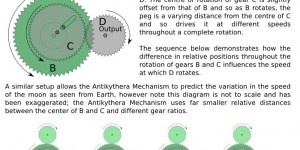
Whatever the original purpose of the Antikythera Mechanism it is abundantly clear that it represented the absolute state of the art in astronomy at the time; one particularly satisfying design within it takes into account the first lunar anomaly i.e. the fact that the speed the moon appears to move from earth is not constant. The diagram below explains how this works:

Diagram showing how the Antikythera Mechanism accounts for variation in the observed speed of the moon from the earth

The video below shows the current best reconstruction of the Antikythera Mechanism which, as far as current research goes, does everything the original did. I hope you'll agree this would have been pretty awe inspiring if encountered in the ancient world; I think it's still pretty clever today - this level of mechanical complexity did not re-emerge until the 18th century when clocks became the order of the day.


Michael Wright of Imperial College demonstrates his reconstruction of the Antikythera Mechanism. At time of writing, this is the first feature-complete model and the most up-to-date in terms of recent research.

Resources

  1. The Antikythera Mechanism Research Project (this is an excellent resource)
  2. Freeth, T.; Bitsakis, Y.; Moussas, X.; Seiradakis, J. H.; Tselikas, A.; Mangou, H.; Zafeiropoulou, M.; Hadland, R.; Bate, D.; Ramsey, A.; Allen, M.; Crawley, A.; Hockley, P.; Malzbender, T.; Gelb, D.; Ambrisco, W. and Edmunds, M. G. (2006) 'Decoding the ancient Greek astronomical calculator known as the Antikythera Mechanism' in Nature 444, 587-591 (doi:10.1038/nature05357).
  3. Antikythera Mechanism - Wikipedia


-