You are here: Home » Issue 12

Issue 12

List of everything in this issue
  1. Article Archaeology: Some Famous Thoughts
    In light of this issue being focused on archaeology and the media, we here at The Post Hole thought we'd ask some celebrities for their thoughts on archaeology. Obviously we had a good starting point in that we already knew Eddie Izzard's opinions on the subject, especially when it comes...
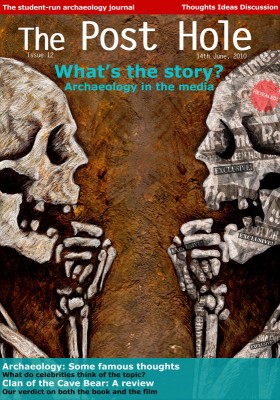
  2. Article Archaeology in the Media
    As archaeology students, we are perhaps more in-tune with archaeology in the media, with frequent access to archaeological journals, our own reading for coursework (for the model student at least), and our personal interest in the subject sparking us to turn up the television when archae...
  3. Article IPUP Conference 2010: Packaging the Past for the Media
    The Institute for the Public Understanding of the Past held a conference entitled "Packaging the Past for the Media: Communicating across Museums, Television, Radio and the Internet in a Multi-Platform Era" at the University of York on Wednesday, 18 May 2010. The conference br...
  4. Article Who wants to be a TV star?
    As a Curator of Egyptology for a museum in the North East of England, I have done my fair share of local media interviews to promote our collections. Personally, I have always found these experiences to be fun, even if many of the interviewers do end up misquoting what I've said or (ir...
  5. Article Interview with Club Secretary, Phil Dunning, of York and District Metal Detecting Club - 11 June 2010
    Thanks Erin for giving me the opportunity to put forward my personal thoughts on the questions you have raised. Figure 1 - York and District Members at their Annual Rally (Photo Credit:Phil Dunning) Erin Lewis - How long have you been a metal detectorist? Phil Dunning - I've b...
  6. Article When Indy met Xena: the Xena Scrolls
    For me, the word calls to mind rare evenings when my mum let us eat dinner in front of the television. The series was one of many things which led me to have a fascination with the Classics and ancient history. For those of you who were unlucky enough (or not quite geeky enough) to hav...
  7. Article Clan of the Cave Bear: A Review
    Despite being a work of fiction, the novel of the Clan of the Cave Bear by Jean M. Auel seems to have become something of an archaeological institution. But how many of us have actually read it, or been tempted to watch its lesser-known film adaptation? This article will review both the...
  8. Article Interview with the Senior Editor of Archaeology Samir S. Patel
    Christina Cartaciano - How did you become involved with Archaeology? Samir S. Patel - I trained as a science and environmental journalist and had never written about archaeology before I joined the staff here. I learned of the position through a colleague with whom I had worked at...
  9. Articles Read the whole of issue 12 online
    Ideal if you want to skim over everything quickly,
  10. Adobe PDF Issue 12 (PDF)
    Download the whole of issue 12 in PDF format. You can read this offline and it is optimised for printing.

Get Adobe Reader The list above contains links to all individual articles in this issue and the option to download it as a PDF. Most computers will already be able to open PDF files but if you can't you'll need to download a copy of Adobe Reader by clicking on the logo to the right.

Goodbye from the Editor

So it's the middle of June and, as usual much more quickly than you would think possible, we have come to the end of another academic year. This Issue marks the end of the current team's incumbency as the Post Hole 'guardians' and it's time to pass the reins. It's been a brilliant year and I know that the whole team has really enjoyed reading submissions and producing an informative, often light-hearted publication. For me, it's been a very special experience to be involved in the Post Hole with a great team of people. I hope you all have enjoyed reading what we have so enjoyed producing! Thank you to all our readers for your continued support.

All that is left is to wish Christina Cartaciano and Dave Farnell, our Press & Publicity and Web team members, good luck as they carry on with the Post Hole into the new academic year. I hope they will be joined in the Autumn by some budding new members and I look forward to seeing what exciting changes they make!

Erin Lewis, Outgoing Editor

Archaeology: Some Famous Thoughts

Keri Rowsell
Keri Rowsell

In light of this issue being focused on archaeology and the media, we here at The Post Hole thought we'd ask some celebrities for their thoughts on archaeology. Obviously we had a good starting point in that we already knew Eddie Izzard's opinions on the subject, especially when it comes to archaeology on TV;

"I quite like it, it's a sort of detective thing but it's really tricky, you know, it's there. But it's kind of slow on telly. It has this problem of, 'We've been here three weeks on live TV and we've dug up a millimetre of topsoil so far.' It's too slow. Our attention spans are short. We want, not slow archaeology, we want speed archaeology. 'You've got minutes to find a city!' 'All right! Let's go! Get the diggers in! Get that skull out of the way! Pottery everywhere!' And they always find in archaeology, a series of small walls. Every time, a series of small walls. 'We found a series of small walls, we're very excited. We think this proves that they had walls in olden days.' And then someone, very learned with glasses, says, 'The King and Queen entertained here. Courtiers and soldiers in this room. And elephants dancing hopscotch over there. Mad fiddler in this room, playing the banjo. Viaducts and aqueducts...' And you watch going, 'You're making this up, mate. You just point at a series of small walls and say, 'Tutankhamen played banjo in there.' You don't know if it's true.'" (Izzard 1997).

Following this, Izzard went on one of Time Team's 'Big Dig' programmes in 2003 and had a go at wielding a mattock himself. Unfortunately for him, he ended up digging a test pit and finding nothing but natural clay, but how many of us can't relate to that? I know I can.

Over the last few months, many emails and letters have been sent out by the team to try and find out what other celebrities first think of when someone mentions the word 'archaeology' to them. Detailed here are a few of the responses we received.

BBC Radio 2's Chris Evans and his team came up with "trowel, dinosaur and mud", while Colleen Nolan said, "dinosaurs and ruins".

Hunter Burgan (American musician and bass player for the band 'AFI') told us: "I think of the DIG project I worked on in 6th grade. It was an archaeological/anthropological assignment where the students broke into two groups, created artefacts that reflect every aspect of a fictional civilization and buried them in the woods for the other group to find. It was a blast. Some of them are probably still buried in the woods. I wonder what future civilizations will think if they ever find those artefacts."

However for some, the first thing that they appear to think of when someone says 'archaeology' to them is themselves. For example, in their replies to us, David Tennant and Noel Fielding both sent signed photos of themselves and, while we're obviously grateful for those, academically we're not too sure we'd agree that they accurately represent archaeology!

Without doubt our most in-depth response came from our recently re-elected Labour MP here in York, Hugh Bayley, who has a long-standing interest in archaeology which has influenced some of his political work. He told us:

"I would have been seven or eight when I went with my sister, Justine, who was two years older, to 'dig' a Roman villa at Cox Green. We were given a little pit to play in, on the corner of the site. I still have a grey shard of 'Roman' pottery which I found. Justine went on to a lifetime's work at English Heritage's Ancient Monuments Laboratory. She analysed many of the inorganic finds from the York Archaeological Trust's Coppergate dig, and has just retired. I veered away from archaeology into politics. As a young boy I was fascinated that archaeologists could examine a broken piece of pottery and be able to date it and make a drawing of what the complete pot would have looked like and how it would have been used. As I got older I realised there was more to archaeology than just broken pots. By studying artefacts and remains we get an insight into how we have altered as people, as a society and how we have changed the environment we live and work in. Living in York has increased my interest in archaeology.

York has a unique uninterrupted history of human habitation covering two thousand years and we need archaeologists to painstakingly uncover and preserve our history. I meet regularly with representatives from the York Archaeological Trust and the Council for British Archaeology which is also based in York to discuss their current projects and any issues they are concerned about. For example we met recently to discuss the draft Heritage Bill which proposed revoking the Area of Archaeological Importance designation. York is one of just five places in the country designated as an Area of Archaeological Importance and the designation requires archaeological assessments to be made before the utility companies are allowed to dig up the roads. I took a deputation of archaeologists to Westminster to see the Culture Minister about this issue, and she agreed to keep the designation.

I am a member of the All Party Parliamentary Archaeological Group and have welcomed members of the Group and government ministers to York to highlight the important work our archaeologists undertake. Archaeology isn't just about the distant past. It is fascinating to see the excavation of the Hungate site unearthing memories of life in one of York's poorest areas at the beginning of the twentieth century, and to meet some of the people who lived there who recognised their old homes and to hear their stories. I was pleased to be asked to write the Forward for Van Wilson's oral history about Hungate. It connects with my own interest in social policy, and Seebohm Rowntree's classic study of poverty in York at the turn of the nineteenth and twentieth centuries. Before being elected as York's MP I spent some time as a lecturer at York University's Department of Social Policy."

So there we have it. For a few celebrities it makes them think back to their childhood (in some cases, a childhood that influenced their adulthood), for others it conjures up images of muddy archaeologists trowelling away in a field somewhere, and for some the word 'archaeology' reminds them of dinosaurs (which, like the signed photographs, doesn't quite accurately represent archaeology, but it’s close enough). I would like to take this opportunity to thank all those who took the time to respond to us and let us know what their thoughts are about archaeology, and also for the two very lovely photos that we gained as a result!

Bibliography

  • Izzard, Eddie (1997) Glorious, DVD, Universal Pictures UK, 4 October 2004 Time Team (2003) Time Team: Big Dig, TV, Channel 4, 29 June 2003

Archaeology in the Media

Henry Miller

As archaeology students, we are perhaps more in-tune with archaeology in the media, with frequent access to archaeological journals, our own reading for coursework (for the model student at least), and our personal interest in the subject sparking us to turn up the television when archaeology is mentioned or zeroing-in on archaeological headlines when flicking through a newspaper. This is likely not to be the case with the general public. The media has a role in informing the wolrd about archaeology but how big is this role? When is archaeology expressed in the media, for what reasons, and how frequently does it appear? Does this reflect the financial aspirations of the media as an industry? Does archaeology even need the media for it to contine to attract attention and interest as a whole? These are the questions which this article will adress.

Finds

The media portrays archaeology infrequently in the UK, the most recent high profile find being the Staffordshire Hoard, found in July 2009. The hoard consists of over 1, 500 beautifully crafted pieces of gold and silver, dated to the 7th century AD (Anon, n.d.). Worth around £3.3 million, it has obviously gained much media interest. Finds such as this are fundamentally why the coverage of archaeological excavations is not particularly high profile, because such a large percentage are not associated with great hoards of gold, but pottery, postholes, ceramic building material (CBM) and the odd coin.

Most digs do produce an amount of 'small finds', whether it is coins, glass, jewelry, or rare or interesting items for the site in question. However, on the whole, these are usually uninteresting to people outside of the archaeological community, and of little value to the media, especially where the majority of the archaeology recovered is gravel with a small scatter of flint tools. This is not going to make them money and perhaps explains why Joe Public's historical knowledge is of later periods such as the Romans and the Tudors, where finds tend to be more numerous, with Rome itself and all its associated monuments, and finds such as the Mary Rose being relatively high profile visitor attractions.

Therefore the media tends to focus on extraordinary or rare finds such as the Staffordshire Hoard, which is not only worth a lot of money itself, but will generate a large amount of interest in the public with paper sales and television ratings.

Accessibility and Advertisement

Archaeology as a resource and as an aspect of national heritage is, in some respects, accessible to the public without the media's input. We have various museums, existing archaeological sites and buildings (such as the Tower of London), along with a myriad of information available both on the internet and in libraries. I would, however, argue that these resources are poorly advertised and of limmitted apeal to the public.

Museums, on the whole, exist in many towns and cities. However, unless you are a parent intent on expanding your children's cultural and historical knowledge, or have a genuine interest in the displays, then you are unlikely to spend money and time dawdling round an exhibit, visiting a monument or taking out reports on archaeological excavations. An exception to this would be something akin to the National History Museum in London which is both free and incredible in its coverage, making it interesting, at least in part, to even the most pessimistic of museum visitors.

Nevertheless, I do think that there are a large number of people who do have a genuine interest in heritage and archaeology, especially in England due to our national character and the diversity of our past. I would therefore argue that people visiting archaeological resources do so despite the little media coverage given to them and their small appeal to the general public.

Archaeology is therefore fundamentally available to those who wish to access it. Museums, heritage sites and libraries are all existent but they are not forced down our throats via advertisements or newspaper headlines. The media has little part to play in advertising these kinds of archaeological outlets simply because the heritage services and local libraries do not have the funds to pay for such things as television advertisements, billboards and the like. How often do you see an advert for a museum, national heritage site or a library's new collection of historical journals? Consider how popular sites would be if archaeology was given the kind of press coverage that the FIFA world cup is currently allowed: Staffordshire Hoard posters throughout Tesco, Jorvik being advertised on Mars bars, or the National Museum being the official sponsor of Britain's Got Talent?

Archaeology and Television

Despite this lack of funding, archaeology still manages to seep into the mainstream media in some respects. Time Team is probably the most well-known 'archaeological resource' available to the public. As an archaeologist, I dread the continual 'So, you're an archaeologist - like Time Team, yeah?' that is issued from most people who do not understand what real archaeology involves. Time Team is what people imagine to be 'real' archaeology, because that is what they are shown on television. In this way the media has given an inaccurate interpretation of what archaeology is, which at times can be either beneficial or very detrimental.

In my opinion, Time Team is, for the most part, a positive thing. The show gives viewers, especially young children, inspiration and insight into a career in archaeology, and generally promotes the profession. On the other hand, it could be said that it is 'dumbing-down' the profession and making a big deal about unimportant, but flashy finds, therefore giving people a less serious view of archaeology as a whole. Overall, television shows such as Time Team provide a valuable gateway to archaeology in the UK and, whether or not it is successful in accurately presenting the subject, it nevertheless promotes it. After all, 'there is no such thing as bad publicity'.

Conclusion

Archaeology does appear in media all over the world. In general, the subject appears only in the news as high profile coverage when something influential, extravagant or expensive is found, due to the financial nature of the media as an industry and the capitalistic trend of our global society. On a more practical level, perhaps newly discovered archaeology does not show in the media simply because there is too much of it, with most having little significance for the general public.

Museums and excavations are not frequently advertised in the media, but continue to gain interest and visitors because of a seemingly national interest in the past, along with football and rugby.

In the end, archaeology will always have a place in the hearts of all human beings because of a want for knowledge and understanding of the past, to know what happened to our ancestors and where we came from. For this deeply internal reason alone, despite little media coverage, people will continue to be interested in archaeology, visit museums and sites, and sustain the profession in the years to come.

Bibliography

IPUP Conference 2010: Packaging the Past for the Media

Christina Cartaciano

The Institute for the Public Understanding of the Past held a conference entitled "Packaging the Past for the Media: Communicating across Museums, Television, Radio and the Internet in a Multi-Platform Era" at the University of York on Wednesday, 18 May 2010. The conference brought together people from a wide range of careers, from archaeology academics to media professionals. The purpose? To discuss how the past could be effectively wrapped and distributed to the general public.

The overall theme of the afternoon seemed to be story-telling: the best method to get non-academics interested in the vast realm of the past, whether it be prehistory or recent history, is to tell a story. This story, in order to be effective, must gain the empathy or sympathy of the audience. Discussions over cups of apple juice after the conference about whether this is the right method for archaeologists to disseminate their knowledge will be expounded later. For now, I will introduce the keynotes and their presentations about how the past, over the last century but especially the last decade, has been rewrapped in the different media outlets and presented to the public.

The Keynotes and Panel Discussions.

The first of our keynote speakers was Martin Davidson, BBC Commissioner for TV History, and he divulged the secret behind what sells and what does not. He traced the origins of the present public obsession with the past, especially on television programming, talking about a massive shift in interest and the way historical programs were produced.

He began with a clip of Alan Taylor's 30-minute presentation on ITV in the late-1950s, where the producers could not believe that the general public would find a talk about history to be interesting. However, not only was the speaker engaging, the audience was entranced. This was a sample of the power the past held, and 40 years later, the public began desiring more programs that gave them a glimpse into other lives. However, this audience is very diverse and has different interests, the reflection of which can be seen in the variety of history-related shows produced in the last decade. Davidson attributes this partially to the millennium event, as well as the related, nearly simultaneous shift in publishing, where historians were writing grand narratives for the public's consumption. Much to everyone's surprise, these new books and programs were generating massive amounts of revenue. People desired these supposedly boring subjects of decades long research, condensed into academic novels. The media followed suit and took advantage of this new avenue of consumption, and the period of past-obsessed audiences began.

Davidson went on to tell the conference audience that the past is most sellable via empathy-engaging stories. His talk neatly segued into Chief Curator Lucy Worsley's presentation on her responsibilities with the Historic Royal Palaces, and the celebration of Henry VIII's 500th birthday at the palaces he built and inhabited. She discussed the increase in visitor numbers due to the effect of media focus on particular subjects, as well as a reconstruction of these heritage sites as leisure family destinations. She discussed the transformation of Hampton Court Palace's displays, from the typical linear, mainly information-drowning board journeys to an engaging and enjoyable experience, complete with actors and novel but factual storylines. Worsley discussed the part played by the literature and TV shows in attracting visitors to these sites that usually languish with small numbers of elderly visitors.

The afternoon continued on with a more obvious archaeologically relevant panel discussion about the BBC and British Museums' "A History of the World in 100 Objects". Representing the British Museum (BM) was J.D. Hill (Research Manager) and Frances Carey (Senior Consultant for Public Engagement), and together with BBC Online's Head of Interactive for Nations and English Regions Daniel Dodd. Each had a chance to speak for 15 minutes about their roles in planning this massive project together and presenting it on many platforms: the radio, Internet and in museums. The sheer amount of collaboration and networking was gargantuan and intense but had significant outcomes, bringing together neighboring museums as well as setting up firm connections to their local radio stations.

Daniel Dodd talked about this collaboration and tracked its progression through the planning stages. There were different agendas and priorities, as well varying ways and timescales of working. All of these had to be integrated and changed in order to make the program successful. Dodd continued on with a discussion of whether the project encouraged audiences to use multiple platforms; for example, after hearing about an object on BBC Radio 4, would a listener then go online to look at an object and follow links to local events at museums? Would the listener attend these open events for a chance to look at some of the objects?

The online portion of this program enabled the public to upload pictures and stories of objects they felt significant in their local, national, and possibly global histories. This in turn led to some serious questions about legacy and responsibility of the academics involved. At what point was something "worth" considering as a historical object? What could be the criteria? And, at the end of the radio program, how would the BBC and BM let the project die down? All of these questions had their moment to be addressed during the conference.

Finally, the last panel of the afternoon featured Janet Barnes, Chief Executive of the York Museums, Jake Gilmore, the Arts and Humanities Research Council (AHRC) Public Affairs Officer, and Bloomsbury Academic's Managing Director Jonathan Glasspool. As it was the end of the afternoon, each presentation was cut very short and few questions could be asked. However, the "Impact of ‘Impact'" panel managed to present some key points about academia and the public. Barnes discussed the collaboration between Yorkshire Museum, the Castle Museum, and Harrogate Museum, as well as the collaboration with the local BBC radio station. Gilmore highlighted the importance of selling archaeology to the public and validating the expenses that such studies take. Glasspool shamelessly promoted the new company, but also reminded us of an important point- that is, making our research universally available. What Bloomsbury Academic hopes to do in the future is to make available those few copies of site reports and volumes of finds available online to students and other academics. It was on this point that the conference came to a close, out of time for any more questions and further discussion about Barnes' experiences with the media, Gilmore's points about archaeological research and Glasspool's company's potential to bring such research to a large audience.

Discussion

Tell a story, and preferably one that touches on the consumer's emotions.

Generally, this was the advice we were given. A few of the fellow archaeologists present took issue with this. How could we freely create stories about the past, especially regarding prehistory where many holes in the greater picture exist? Davidson believes that an effective show about history stimulates "latent" curiosity via captivating the audience's attention by tickling their emotions and appealing to their empathy. It was no coincidence that he predominantly showed clips where the show's subject was displaying rather strong emotions.

More importantly, as one archaeologist commented, how would archaeological science fit into this storytelling? Clearly the archaeological research done in biology and chemistry labs across the U.K. has importance and should be disseminated to the public, but how would we present it as a story? Should we even bother presenting it to the laypeople if they will not find it interesting?

I believe that archaeological science provides greater insight into the past, with much more scope than the simple macroscopic analyses of past archaeologists. I also believe that while the exact scientific methods employed would bore lay people to death, I think that the results would spark "latent" curiosity and find a niche in the masses of people. Returning, then, to that last question of whether we should bother with packaging this specialized knowledge, I think we must address why such research is being conducted. Jake Gilmore briefly touched on this with his presentation about the AHRC's funding grants. Clearly our research of past material culture, whether scientific in method or not, is important, and is interesting to many people outside of archaeological academia. Many people want to understand where we come from, and what we have achieved in this past. If this was not so, then programs like "A History of the World in a 100 Objects" would not be successful.

The conference demonstrated the ways in which we should rework the formula for how we present the past to the public, using tools such as the media and collaboration with other learning outlets. Yet, it fell short of really advising archaeologists who are uncomfortable to create an emotional story out of the past. Would we be sacrificing our academic professionalism and selling our souls by sensationalizing our research? Or do we owe more to the intent of archaeology to understand our past and to disseminate such knowledge to other human beings? Is there not a middle ground where we could engage the public's interest without pretending to really know who these people of the past are? These are questions that we need to answer as our technology advances and creates more outlets for us to utilize. They are questions that are going to be grappled with in many an archaeologist's conscience. They must be dealt with soon, because the public does not seem to be slowing down in its desire to know more about the past.

Who wants to be a TV star?

Gillian Scott
Gillian Scott

As a Curator of Egyptology for a museum in the North East of England, I have done my fair share of local media interviews to promote our collections. Personally, I have always found these experiences to be fun, even if many of the interviewers do end up misquoting what I've said or (ironically) get my name wrong. So when I was invited to join a team of experienced media personalities to present a documentary series on mummies, to be aired on the History Channel back in 2006, I jumped at the chance. What could go wrong?!

For obvious reasons, the names of the innocent (and not so innocent) have been protected, but in the weeks and months that followed that initial agreement, I truly had my eyes opened up to the strange world that is television.

Often, when we think of television programmes featuring archaeologists, images of rainbow-jumper wearing, mud-covered middle-aged men bouncing between excavation pits wielding pottery fragments spring to mind. However, the production company behind this new series wanted something slicker, sexier and more akin to CSI (although I should state that 'slick' and 'sexy' are not words that are immediately conjured when people do actually see me). Nonetheless, as the youngest present (I was 25 years old at the time), it was perhaps thought that my eager enthusiasm mixed with my awe-inspiring knowledge on the subject of mummies would win over viewers.

I was sorely mistaken in thinking that there would be a substantial budget for this project. Our main "lab" was the computer room within the University's Department of Archaeology, which had been "made over" to include a pin board and a flickering light box for looking at X-rays. It soon became a competition amongst the cast to try and comically reposition the skeleton that featured in the background in every episode without the director noticing. More often than not, this would include rude finger gestures, holding signs or wearing items of clothing.

What surprised me the most was not the long hours that we had to work, or even the number of takes it took to get a shot of us walking down a pathway looking pensive, but the actual lack of lead-in time that we got to prepare for each mummy 'case'. More often than not, we would go in blind and be expected to talk on subjects that we weren't always familiar with, which sometimes included the results of scientific tests that hadn’t been carried out yet. The way around this was often through ambiguous statements or suggesting different reasons for the discovered outcome. Towards the end of the project, we were often called back to re-shoot parts so that they matched properly with the scientific findings.

My main role on the programme appeared to change from episode to episode. One minute I was a museum curator, the next I was a conservator and at one point I was an archivist. To be honest, my CV has never looked so good! However, I know from having spoken to people who watched the programmes that it just seemed as though I was a bit of a lost soul with no sense of purpose- the dogsbody of the team. To top it all off, I was even missed out of one episode entirely after a rift with the Director over changing the shooting dates at the last minute, which conflicted with my 9-5 job schedule.

So how did it all pan out? Well, the 6 x one hour documentaries aired in January 2007 with little pomp and circumstance (due to overspending in production I believe) and in addition to the programmes being shown in this country, they were also on TV in North and South America. I had an email from a strange guy shortly afterwards- my only piece of fan mail to-date, which read:

"Can I just say that I enjoy the Mummy Forensics programme although the continued repetition of facts in issue is annoying but symptomatic of these sorts of programmes today - I presume for the American market who seem to forget what they have heard during the 2 minute advert break and need reminding.

But I am writing to you because I think you are absolutely gorgeous. I have noticed many beautiful archaeologists on TV programmes such as yours and Time Team but you are the most beautiful of all. Thank you - you brighten up my week."

I have absolutely no idea who this man is but have often wondered since as to whether he was ever released from the funny farm from which he sent this email. The mystery man did make one valid point however. Even I couldn't fail to notice and become frustrated at the number of times the narrator stated the blindingly obvious. At one point I actually became paranoid that maybe as a presenter I hadn’t made things clear enough for the viewer, but sadly this is endemic within the numerous TV shows that follow a 'CSI'-style format. Producers, please, I implore you- frequent repetition kills any form of suspense and mystique. It also surely detracts from the expert presenter's time and I would like to think that is what people tune in for.

Several years on from that experience I realise that I was perhaps incredibly naïve to think that I would be God's gift to the television presenting world, OR that I was even what could be considered an 'expert' in the field of human remains and mummies, OR that I would have any say over the way that things were done. The process of being filmed at multiple angles repeating the same information over and over became quite laborious- as did the task of having to pretend I was hard at work doing background research on the computer, when really I was Googling job vacancies at the British Museum.

Would I do it again? Well, yes, probably- if I got paid (note to all budding TV presenters- check your contracts before signing your life away). However, I think the main thing I took away from the whole experience was that what goes on behind the scenes in television is very different to how we all think it would actually work. The next time you watch an archaeological programme like these and find yourself screaming at the presenters on TV for making such absurd, sweeping statements, try to have a bit of sympathy. More often than not their academic expertise stands for absolutely nothing if it contradicts the overall vision that the production company has for the project! Let’s face it, how many TV producers want to hear the words "we just don't know"?

Interview with Club Secretary, Phil Dunning, of York and District Metal Detecting Club - 11 June 2010

Erin Lewis
Erin Lewis

Thanks Erin for giving me the opportunity to put forward my personal thoughts on the questions you have raised.

York and District Members at their Annual Rally (Photo Credit:Phil Dunning)
Figure 1 - York and District Members at their Annual Rally (Photo Credit:Phil Dunning)

Erin Lewis - How long have you been a metal detectorist?

Phil Dunning - I've been a metal detectorist for about 8 years now after working in the Electricity Supply Industry in the Design of Protection and Control Systems and in Project Engineering the installation of control systems at Substations for the National Grid Company.

EL - What first got you interested in the hobby?

PD - I saw it mentioned on the Internet and bought a magazine. There is a little ploughed land available near where I live so I joined the York Club who have outing organisers who obtain permission to detect on local farms. The members pay to attend each outing, the proceeds over the years have been given to over 30 charities.

EL - In your opinion what is metal detecting about compared to how it is presented in the media?

PD - I think the media is misleading people as to what the hobby is really all about, resulting in 'treasure hunters' instead of 'history hunters' buying detectors. People who buy detectors for finding treasure (which is legal), are not necessarily interested in saving our history for future generations which is the ethical aspect to the hobby and is so important.

I wish the media would present a properly balanced view of the hobby and attract more people who want to contribute to the history of our country. (Click here for further details)

EL - How important is metal detecting to the study of the past?

PD - More important than some of the archaeologists, detectorists and general public realise, we are all somewhat illiterate until informed on this specialised subject. Metal detectorists are now an essential part of a team on archaeological digs and come into their own at flagging up new sites due to high concentrations of finds and can determine the location of battlefields and troop positions by the fall of shot and items lost during the battle. (Click here for further details)

York and District Member looking for evidence of the Battle of Stoke Field(Photo Credit:Phil Dunning)
Figure 2 - York and District Member looking for evidence of the Battle of Stoke Field (Photo Credit:Phil Dunning)

Recording find spots to 6, 8 and 10 figure National Grid References (NGR's) benefits our heritage in many ways; Domestic utensils and surface pottery remains show areas of occupation. Tools, worked or repaired objects and materials show the location of workshops, technologies and resources used in manufacture, patterns of production, the geography of local and overseas trade and communication.

Artefacts compete to be the only existing complete example and the most fully recorded example. Their format, design, function, use, wear and repair show us how they changed over the years. Jewellery shows us the dress style of the area and period. Coins show us how the Emperor or King dressed and even how he wore his hair. Even the humble grot or brooch can show us the date of a particular site and places where trade took place. Votive offerings, weapons, musket balls and grave goods, show us how and where our ancestors worshipped, fought and died.

A concentration of objects found in a small area might lead to a new archaeological site such as a settlement, temple, fort, workshop, burial/cremation, battle ground or market place etc being discovered, or show where a hoard was buried.

Another advantage of finding objects in a small area is to be able to date the site (made easier by dating any coins found), so dating other objects found in the same area that previously were undated. Dating objects on one site assists in the dating of objects on other sites too. Knowing where nothing is found is also valuable 'negative evidence' for the Finds Liason Officer. Detecting finds throughout Britain are daily adding to and even re-writing our history for the benefit of future generations.

EL - There is a code of practice which recommends how to go about metal detecting but it is voluntary, do you think this should be enshrined in law and why?

PD - I think it would be impossible to police if made compulsory. Since the setting up of the Portable Antiquities Scheme (PAS)over 568,000 objects have been recorded by over 17,000 people, the vast majority being detectorists. The number of PAS recorders is steadily growing due to PAS outreach.

I particularly appreciate and welcome the visits of Liz Andrews-Wilson to our Club (PAS Finds Liaison Officer), and Sam Moorhead (specialist on Iron age/Roman Coins). Liz takes our finds to the Yorkshire Museum, identifies, weighs and measures them, records them on the database and returns them to the Club free of charge. Anyone joining the Club MUST agree to record with PAS.

EL - How would you recommend going about getting involved with the hobby for first-timers?

PD - I would recommend joining a Metal Detecting Club such as York and District, the advantages of this are that land is available, you can make new friends and get help along the steep learning curve.

Clubs are often invited to get involved in Community Archaeology Projects for example the York Club has just completed a survey at Heslington where the University Campus is being extended. The survey, headed by Steve Roskams and Cath Neal was attended by 16 of our members who between them put in 36 man days detecting of which the Club is very proud. (Click here for more information on getting involved)

Alternatively a forum like UK Detectornet (UKDN) can provide vast amounts of information about the hobby which can be studied at your convenience and you can make online friends too. The site is dedicated to promoting Responsible Metal Detecting and fully supports the PAS.

UKDN Banner
Figure 3 - UKDN Banner

One of my concerns: The present system of surveying land prior to construction of roads, supermarkets, estates, university complexes etc, allows only a tiny percentage of a site to be surveyed and the vast majority of detectable metal finds to be covered in tarmac or built on. Also many Battlefield sites are unprotected and at risk from the plough, chemicals etc.

There is an army of metal detectorists willing to help with surveys and confirm battlefield locations and unlock their history, please let us help more, we have Club members ready and willing to do this free of charge.

Please record your finds with the Portable Antiquities Scheme for the benefit of future generations

Many thanks to Phil for his time and interest.

When Indy met Xena: the Xena Scrolls

Megan Lewis
Megan Lewis

For me, the word calls to mind rare evenings when my mum let us eat dinner in front of the television. The series was one of many things which led me to have a fascination with the Classics and ancient history. For those of you who were unlucky enough (or not quite geeky enough) to have never seen the series, I'll give you a very brief overview. 'Xena: Warrior Princess' follows the adventures of Xena (unsurprising) and her irritating, blonde sidekick Gabrielle as they wander through a mythic landscape which spans thousands of miles and several millennia (Weisbrot 1998: 228). They encounter gods, fight in the Trojan way and meet historical figures like Julius Caesar and the Greek poet, Homer. The series draws from classical mythology, literature and even historical events. It is perhaps unsurprising therefore that archaeology is also dragged into it. In fact, there is a whole episode dedicated to it.

'The Xena Scrolls' is an episode set in the 1940s and stars Lucy Lawless (Xena) and Renee O'Connor (Gabrielle) as the descendents of their regular characters. Janis (the descendent of Gabrielle) is a character who obviously owes much to the Indianna Jones films, as is evident from merely looking at her costume. She also wields a whip and has the same peculiar obsession with keeping her hat safe. Janis is looking for the so-called 'Xena Scrolls'; the scrolls recording their adventures as written by Gabrielle. Over the course of the episode, the normal roles for these two actresses are drastically reversed with Janis taking the lead in a way Gabrielle rarely does, whilst Mel follows along like the lamb Xena is not. Of course, this does not last for the entire episode and it culminates with Xena's spirit inhabiting the body of her descendent to defeat the god of war, Ares, who Janis and Mel have inadvertently released from his tomb.

As I previously stated, the episode owes much to the Indianna Jones films. Not only are the characters similar, the plot follows a similar path. The archaeologist-explorers venture into forgotten tombs and caverns and are faced with some kind of mystical force. The Christian overtones of the films can obviously not be replayed in Xena, focusing as the show does on classics and the Greco-Roman deities but the religious connotations remain in place.

The question is how much does this episode owe to actual archaeological practises? The answer is simple. Almost none. There are dig sites in the opening shots as the camera pans across the landscape, but there the realism ends. The episode is more a parody of Indianna Jones, itself a fictional stereotype, than an accurate portrayal of the discipline.

Xena and Indianna Jones show the archaeologist as some kind of explorer who has to fight their way to a mysterious and powerful artefact, often needing to protect it from those who would use it for evil purposes. Of course, the archaeologist only wishes to find this object to further academic learning, to prove their father right or to prevent it from falling into the wrong hands - they never want the power for themselves. This archaeologist is a trained fighter who can dodge bullets and is hunted by archetypal 'bad guys'. The discipline is shown as one long exciting adventure. Even in Indianna Jones when Indianna is shown teaching classes, he has an air of mystery about him which seems to bewitch his (female) students. He seems to be merely killing time until his next adventure.

Does this portrayal of the archaeologist-explorer mislead the public perception of archaeology? Does it create an image of the archaeologist so far from the truth that archaeology undergraduates are sorely disappointed when they arrive at their first dig to find rain, mud and cups of tea? To get to the bottom of these questions we must consider the target audience and how serious this portrayal is. Xena is, quite obviously, aimed primarily at children and young people. Those adults who watch it tend to be diehard fans - it has something of a cult following. There may be a slight impact on a child's perception of archaeology but the manner in which Xena is written leaves the more mature viewer in no confusion as to how realistic the show is. The gods personified, the constant comedic moments and the deep interaction Xena writers have with their fans all serve as constant reminders that the show is not even based on reality. Viewers who are familiar with the Indianna Jones films will see this particular episode as a kind of spoof of the films - again, not something to be taken seriously.

I would go so far as to say that this episode and the Indianna Jones films help to interest younger generations in the discipline in a way that something like Time Team may not. They are exciting things to watch and involve adventure. Xena also features two very strong female role-models, which enables girls to see themselves in the place of the characters. If this interest is continued and leads to a student applying for a place at university to read archaeology, I would count that as a bonus! The likelihood of such a student having done no further research into the field apart from having watched these films and dramas is very, very slim. If they have done so little preparation then I would argue that they almost deserve to have their preconceptions shattered by the rain and the mud. The inclusion of mythical figures ought to have raised at least some questions in the student's mind as to the accuracy of such portrayals.

I would even go so far as to argue that the depictions of archaeologists in Xena and Indianna Jones are less misleading than Time Team. At least Xena and Indianna Jones do not claim to be realistic or accurate.

Bibliography

  • Weisbrot, R. (1998) Xena, Warrior Princess: The Official Guide to the Xenaverse, London: Bantam Books.

Clan of the Cave Bear: A Review

Adam Cliff, Katharine Newman
Adam Cliff
Adam Cliff

Despite being a work of fiction, the novel of the Clan of the Cave Bear by Jean M. Auel seems to have become something of an archaeological institution. But how many of us have actually read it, or been tempted to watch its lesser-known film adaptation? This article will review both the book and the film and perhaps refresh the memory of old faithful readers and viewers alike and rescue all those interested, but perhaps wary, parties from the throws of indecision...

The Clan of the Cave Bear - Book Review

Clan of the Cave Bear, by Jean M. Auel, is one of those books that I have heard a lot about, but never had the inclination to sit down and read. My friends - most of them females - insisted I should read it, that it was a beautiful story and that I didn't know what I was missing. I would have read it sooner had the fervour surrounding it not reminded me of their failed attempts to get me into the 'Twilight' series. I must admit it was with a certain amount of trepidation that I cracked open the pages of a borrowed copy and settled down to enter the world of the Earth's Children series. Now that I have finished, I don't quite know where to begin.

The book explores the relationship between Ayla, a five-year-old Cro Magnon orphan, and the Clan of the Cave Bear, a band of homeless Neanderthals. The two have been brought together by an earthquake that destroyed both Ayla's family and the clan's cave. There are hints of the difficulties Ayla may face when she is described as 'of the Others' and so should be left for dead. The clan's medicine woman, Iza, feels compassion for the feverish girl who is so close to death after being wounded by a cave lion, and nurses her back to health. The wound is to have implications that are far reaching for both the clan and Ayla. With the help of Iza and Creb, the crippled shaman, Ayla begins to integrate herself into clan life. One of the first things she must learn is how to communicate and this is something that Auel has obviously given a lot of thought to. It has long been argued that Neanderthals lacked the full vocal range of anatomically modern humans (Gamble 2003, 170-174), so Auel endows her Neanderthals with quite an intimate form of communication. Using a mixture of sign and body language the clan use their few spoken words imply different meanings or attract attention. The rest they read from gestures, facial expressions or body posture.

This leaves them in a bit of an evolutionary pickle. They find it difficult to describe something they saw to someone who did not see the same thing. They lack the ability to think ahead, or innovate - something that Ayla seems to do for fun. Only in Creb has this 'gift' of foresight developed even slightly. Ayla's arrival bearing the scar of a powerful totem (the wounds from the cave lion) threatens a rigid social and ritual framework that the Neanderthals have developed to deal with this shortcoming and forces them to make decisions they are incapable of making.

There are numerous messages about today's society woven into the novel and certain character traits and aspects of Neanderthal life are exaggerated in order to emphasise these. The division between male and female members of the clan is such that it often seems they could be a different species altogether. As Ayla grows, she attempts to conform to a society where male domination affects nearly every aspect of a woman's life, but finds it difficult to accept what has become instinct to the clan's women. This infuriates one male in particular, Broud, the future leader of the clan. The struggle for power between the two acts as a catalyst for many of the events in Ayla's life.

It is obviously a very well-researched book. Auel has left little to her imagination when it comes to flint knapping techniques, communication or the surroundings the protagonists find themselves in. The world she creates is so rich and vivid that the reader can't help but be drawn into it. There were many times when I found myself thinking 'just one more chapter, then I'll sleep…'. The result of this attention to detail is quite a slow-paced narrative that seems to mimic the way of life of Auel's Neanderthals. This is punctuated by swift moving events that come and go in a matter of two or three paragraphs. I enjoyed the book, though I maintain it is certainly geared towards a female target audience. There were times when I felt I was peeking through the curtains, spying on a conversation I shouldn't have been privy to. I would also warn readers that I found it so easy to become engrossed in what is ultimately a work of fiction that I began criticising it when it left the archaeological script and wandered into the realms of fantasy. A number of times I found myself scoffing at some imagined aspect of Neanderthal life such as their 'shared memories' with a wry chuckle and a shake of the head. I would then remember that it is, after all, a work of fiction and admonish myself for being so smug.

Clan of the Cave Bear - Film Review

When I first put this film into the DVD player my expectations were at an all-time low. Having read the book, albeit in the dim and distant past, I had visions of settling myself down for 94 minutes of Ayla, the blonde-haired and blue-eyed female protagonist, swanning around in the midst of hairy, club-wielding and dim-witted Neanderthals, as films and other media tend so often to portray them. Admittedly, they were rather hairy, but nonetheless, I was in for a surprise…

The film, originally made in 1986 and released on DVD in 2005, begins with a textual introduction to the chronological setting of the film, when modern humans are moving into Europe and the Neanderthals are encountering our species (referred to in this film as Cro Magnon) for the first time. The introduction, while brief, is descriptive enough and provides as suitable an introduction for this incredibly complex period as you're going to be able to fit into about a hundred words. The plot then goes on to follow the life of Ayla, a young modern human. As a child, Ayla loses her tribe due to an earthquake, and, following a run-in with a cave lion, is adopted by a passing tribe of Neanderthals, with two of whom, a male, Creb, and female, Iza, she becomes very close. Indeed, the Neanderthals themselves, though hairy, were portrayed in a surprisingly positive light. Although the book focuses largely on Neanderthal societal organisation and complexity, I was prepared for a film glorifying the beautiful modern human, Ayla, transgressing their primitive notions and outstripping them at every turn. Thankfully, this was not the case. Certainly, Ayla is shown to be more agile, faster to learn and even better with certain forms of hunting weapon, but the overwhelming impression I took away from this film was of the Neanderthal way of life. It is, of course, based entirely on conjecture, but this film, and indeed the book upon which it is based, more than anything else I've seen or read academically, or in the public domain, made me think about Neanderthals as entities in their own right.

So often we're concerned with Neanderthals in relation to ourselves - how did our ancestors perceive them; did we kill them; did we out-compete them; are they our ancestors; did we interbreed with them; how similar are they to us today? This film posed questions that I, in all my academic readings, had never paused to ponder - how would we cope within Neanderthal society; how did they perceive the newcomers to their lands? Obviously, this film does not provide the answers, but it does perhaps serve to make us think and talk about so complex a subject of archaeological debate, even if only to outright disagree with it. Although some aspects of this film surprised me, for their portrayal of the complexity, and the subtleties of the similarities and otherness of the Neanderthals, it nonetheless fell prey to some of the most basic stereotypes. Despite recent studies proving that Neanderthals would likely not only have worn clothing but, in order to compensate for the cold temperatures, that clothing and their footwear would have needed to be carefully tailored and fitted to maximise heat retention (Sørenson 2009), film producers and their ilk seem fixated on the notion that past hominins were all voyeurs at heart and insist on clothing them in ill-fitting scraps of animal hide. Neanderthal society is also portrayed as male-dominated, another typical stereotype, and though there are many scenes of hunting, and the importance accorded to it, there are no scenes of gathering behaviour, perceived as a more female occupation, though it was doubtlessly vital to the survival of past populations (e.g. Hill 2002).

The music of the film, while promoting a sense of otherness, does so mainly using guttural animalistic noises and drumbeats, emphasising the 'primitive' nature of the films chief characters. The budget for this film also appears to have been small, based largely on the fact that the earthquake at the start is features a series of about five polystyrene boulders falling unconvincingly down a hill, and that the costumes seem to consist of as little material as humanly possible.

Compared to the book, the film is, in my opinion, inferior. It doesn't absorb you in the same way as the book does, it has nothing like the levels of complexity and you can't form the same kinds of attachment and empathy for the characters in an hour and a half as you can in the days or weeks over which you might read the novel. But there is something to be said for the medium of visual representation. Unlike when reading a book, where the characters exist only in your mind's eye and it might be easy to forget that Creb or Iza is in fact a Neanderthal, in the film you are constantly reminded of their different appearance and this contrasts well with their strikingly familiar behaviour.

In sum, this film is far better than my pessimistic expectations predicted, but it is still far-removed from such archaeological classics as Indiana Jones. However, it does take on a difficult period of prehistory and portray the main characters on that prehistoric stage in an intriguing manner that challenges our preconceived notions. If you want an archaeologist's night-in, something to make you laugh and occasionally cringe, and something perhaps in the future to allow you to have a little more sympathy for the Neanderthal way of life, then this film could be the one for you. Just don't start citing it in essays about Neanderthal social organisation or I will not be responsible for consequences…

Summary

Converting such a rich novel as Clan of the Cave Bear onto the silverscreen would have been a mammoth undertaking. So many different factors have to be taken into account, and things are always lost in translation. There are scenes that would have perhaps been too expensive or technical to shoot, such as the mammoth hunt scene.

If you loved the novel, the film may well serve to bring back those parts you loved best, or maybe even force you back to it to check whether something really happened. Only the pivotal moments make it, and there are times where the producers have decided to exercise a little executive creativity. In market that is relatively uncrowded, the Clan of the Cave Bear stands up well to similar films in its genre. A personal favourite is the 'Quest for Fire', and I would highly recommend it to anyone with even a vague interest in prehistory or Neanderthals.

We hope your next archaeological movie night branches out from the Mummy and Indiana Jones and will leave you with a little piece of trivia. The young Broud, who we see strutting about in Clan of the Cave Bear was played by Joey Cramer, best known as David from Flight of the Navigator… If that doesn't get you down to the nearest video rental shop, I don't know what will.

Bibliography

  • Gamble, C (2003) Timewalkers: the prehistory of global colonization. Stroud: Sutton Publishing.
  • Hill, K. (2002) 'Altruistic Cooperation During Foraging by the Ache, and the Evolved Human Predisposition to Cooperate'. Human Nature 13, 105-128.
  • Sørenson, B. (2009) 'Energy use by Eem Neanderthals'. Journal of Archaeological Science 36, 2201-2205.

Interview with the Senior Editor of Archaeology Samir S. Patel

Christina Cartaciano

Christina Cartaciano - How did you become involved with Archaeology?

Samir S. Patel - I trained as a science and environmental journalist and had never written about archaeology before I joined the staff here. I learned of the position through a colleague with whom I had worked at another science magazine, and within weeks I was on board. My initial thought about joining the staff was that I might feel stifled by the magazine's specific subject matter- after all, a little academic restlessness is what made me choose science journalism over a more traditional career path in the sciences. But that's been anything but the case, there is no end to the variety of the stories we get to tell and I feel privileged to get to tell them.

CC - What made you interested in writing about archaeology for the general public?

SSP - I suppose the answer to this lies in why I became a science journalist in general. As a writer, I am first and foremost a storyteller. Science in general and archaeology specifically provide some of the most compelling, surprising, appealing, and challenging stories out there. Also, archaeology- again, like science as a whole- is a field fraught with public misunderstandings, everything from clingy, outlandish theories to outmoded ways of thinking to old wives' tales that somehow become accepted knowledge. Archaeologists often have a difficult time explaining these muddy areas to the general public, which allows these misunderstandings to gel. We're like the translators who take good research and make it accessible to everyone, giving the general public the chance to truly understand what archaeology does for all of us.

CC - In your opinion, is it important to share archaeological knowledge among the public?

SSP - Archaeology tells us who we were, who we are, and where we're going. People may not realize it, but there's something to modern life that is inherently "archaeological." We collect and amass our own material culture all the time, so it can be the means by which we connect with the world around us and cultures that came before. So archaeology is one of the most accessible and popular fields of inquiry, and the public is hungry to understand it better. It relates us to our ancestors. It makes remote cultures real. It gives us something to share and celebrates the ways in which we're different. Public interest in this feeling of connection drives most archaeological research, but without someone to bring these stories to everyone, it could wither on the vine.

cc - Do you see or have you experienced any downsides to keeping the public informed about archaeological discoveries?

SSP - There are of course times when understanding of a particular culture or time period is incomplete, which can lead to blind alleys, inaccurate theories, and wild speculation. And when we write about those moments, the mistakes we all share--mistakes that are essential to the advancement of any field of science- can become part of the public record. But, in truth, that's not really even a downside, but another chance to tell a story with more detail and rigor.

CC - And finally, what is the first thing that pops into your mind when someone mentions the word 'archaeology'?

SSP - You mean besides the name of the place where I work? I think about what an excavation of my apartment might say about me.


-