The French taphonomy-based discipline of 'anthropologie de terrain' is not an approach I expect many of you to be familiar with. It is a lamentable fact that the research carried out on mainland Europe is often unimplemented in British archaeology due to the language barriers. The trailblazing research carried out on the continent, however, has the potential to revolutionise our understanding of history.
Anthropologie de terrain is an approach that seeks to reconstruct the conditions and evolution of a burial by examining the position of the skeletal remains as they lie in the grave. This technique relies on the absolutely precise recording of each bone as it appears in the grave and is intended for use in the field, during the excavation of the human remains. However, it has been used retrospectively to great effect by Dr. Liv Nilsson Stutz in her analysis of the Danish Mesolithic cemeteries of Vedbaek Bogebakken and Skateholm I & II (2003).
I believe that anthropologie de terrain has the greatest potential in the examination of prehistoric mortuary practise – prehistory, especially the Upper Palaeolithic and Mesolithic periods, has a huge array of burial and post-depositional practises that continue to elude explanation. However, I feel that anthropologie de terrain can help archaeologists attempt to re-evaluate this inexplicable evidence.
Basic Principles of Anthropologie de Terrain
Liv Nilsson Stutz states that "a cadaver is not static, and a body undergoes significant changes from the moment of death to the moment we as archaeologists excavate them" (2003:148). The processes that affect the body during decomposition have the potential to disturb the skeleton in quite predictable ways, and the examination of the skeletal elements in the grave have the potential to provide archaeologists with detailed information about the nature of the original burial conditions.
Henri Duday has been the most prolific French scholar in this field, and has pioneered the use of anthropologie de terrain across the archaeological spectrum. He identifies the main areas of concern for anthropologie de terrain within the study of burials in a recent paper (2006).
Primary Deposits
This is the type of burial deposit that is most familiar to most of us – the deposition of a recently deceased body that has not begun to significantly decompose. This results in the full process of decomposition taking place within the confines of the grave cut. In a primary deposit, the decomposition of the body has a detrimental affect on the articulations of the skeletal structure. The articulations that bind the skeleton in life, the ligaments, tendons and skin, slowly degrade and depending on the strength of these connections, the skeleton will decompose in a predictable manner. The skeletal articulations are classed as either labile (those that will decompose most rapidly, in a manner of weeks) or persistent (those that take months or years to decompose) (Duday et al 1990:31). Labile articulations are generally the smaller and more fragile connections of the neck, hands, feet, scapulo-thoracic junction and costo-sternal joints and require detailed excavation. The persistent articulations are those that have the strongest bonds in life, such as sacroiliac joints, knees, hips, ankles and the lumbar spine. The analysis of the labile and persistent articulations can provide information about the decomposition of the body and the conditions in which this occurred.
A primary deposit in a filled grave will appear differently to the archaeologist than a primary deposit that was allowed to decompose in an empty space. In a filled grave, the decomposition of the body and the degradation of the labile and persistent articulations have limited space in which to move around, they can only move within the empty volume of the original cadaver, subject to the infilling of the decomposed space with sediment. In a filled space, the labile articulations are unlikely to be highly disturbed as the pressure exerted from the sediment and lack of scavenging animals will keep the bones in articulation.
Figure 1 demonstrates the effects of decomposition in a filled space on the labile articulations. The phalanges, metacarpals and carpals (coloured red) of the right hand are still (mainly) in articulation. Duday explains the maintenance of articulation as the effect of "progressive clogging" (colmatage progressif) (Duday et al 1990:40) as the body slowly decayed the sediment filled in the empty volumes left by the absent soft tissue. In a filled space, decomposition creates empty spaces within the volume of the body that bones can move into. This can be seen in Figure 1 – the bones of the left hand (coloured yellow) have fallen into the empty space created by the decay of the soft tissues in the abdominal cavity.

Figure 1: Neanderthal burial from Kebara. After Duday et al 1990:40 and reproduced by kind permission of Bulletin et Memoires de la Societe d'Anthropologie de Paris
Primary inhumation in a filled space, such as a coffin or shroud, can have a peculiar effect on the appearance of the skeleton. The presence of a container or wrappings around the body can affect how the bones appear in the grave. Figure 2 illustrates what is known as "effet de parois", or a "wall effect" on the bones, where something has provided a support for the bones as the body decayed, resulting in skeletal elements that appear to be precariously balanced. This can be seen more prominently in Figure 3, Grave 22 at Vedbæk Bøgebakken where the cadaver appears to have been wrapped in organic material prior to deposition, which results in skeletal remains that appear unnaturally arranged in the grave.

Left to Right Figure 2: Child burial from Coteau Montigne. After Duday et al 1990:41 and reproduced by kind permission of Bulletin et Memoires de la Societe d'Anthropologie de Paris Grave 22 at Vedbæk Bøgebakken. After Nilsson Stutz 2003:237 and reproduced by kind permission of Erik Brinch Petersen)
Primary deposits that have been allowed to decompose in an empty space will appear differently to the excavator. As the body decays, the lack of pressure from surrounding sediment allows the bones to move outside the initial volume of the cadaver. As the connective tissues decay, the bones will rotate outwards, giving the impression of more dispersed skeletal elements. Figure 4 demonstrates the scattered appearance of a skeleton that occurs when the body has decomposed in an empty space. The os coxae (ilium, ischium and pubis) are completely fragmented and illustrate the degree of displacement that can occur during decomposition.

Figure 4: Grave 175 at Aléria. After Duday 2006: 42(Duday 2006:42)reproduced by kind permission of Oxbow Books.
Secondary Deposits
Secondary deposits can be described as depositions of 'dry' bones into what will become their final resting place. Duday (2006) identifies problems with the identification of true secondary deposits – the deposition of the bones could be the result of clearing a grave plot for re-use, thus telling us very little about the funerary rites or practises of the society concerned. The detection of true secondary burials can be determined from the survival of anatomical connections "if the defleshing has been incomplete when the remains of the deceased were transferred to the final resting place" (Duday 2006:47).

Figure 5 - Figure 5: Grave 13 at Skateholm I. After Nilsson Stutz 2003:220 and reproduced by kind permission of Lars Larsson.
Figure 5 shows the disarticulated human remains found during the Skateholm I excavations, although it is difficult to see in the image the connections of the left hand and right foot were present at the point of burial, even though the body was highly mutilated. Nilsson Stutz interprets this as a body that was disarticulated before it was placed in the burial (2003:220), however it could be explained as a secondary burial where some of the articulations were still present at the point of final internment.
Given this brief introduction to the complex and technically skilled area of anthropologie de terrain, what can be said about its application in archaeology?
The application of anthropologie de terrain can provide archaeologists with subtle details about the pre- and post-depositional treatment of the body. These funerary practises are relevant to discussions of gender, personhood, society, rank and a myriad of other theoretical approaches. It is not enough to excavate a body and examine the bones in the hope of ascertaining sex, age or pathological conditions – the position of the bones in the grave can give us a greater degree of subtlety in studying the remains. Anthropologie de terrain can therefore let us access detail that would otherwise be completely ignored by an untrained observer.
As mentioned above, the application of anthropologie de terrain is perhaps most useful in cases where the mortuary and funerary practises are ambiguous, or inexplicable. I believe that the earlier periods of prehistory are more deserving of this kind of attention as the great array of identified burial practises requires a greater degree of skill to decipher and interpret. Nilsson Stutz (2003) has applied the principles of anthropologie de terrain to the Mesolithic cemeteries of Vedbæk Bøgebakken and Skateholm I & II and from her analysis has given archaeologists an unprecedented level of detail in terms of treatment of the body, and from this the wider societal attitudes to death and the dead. The Mesolithic period in particular has suffered greatly from obsessive concerns over rank and economy, and although there has been great advances made in terms of thinking more broadly about Mesolithic society (Nilsson Stutz 2009; Milner and Woodman 2005; Conneller 2009) there remains a discrepancy between the attention paid to diet, economy and technology and the attention that should be given to death, ritual and cosmology.
Anthropologie de terrain can help archaeologists examine these graves in significantly more detail than traditional excavation would permit. However, to use anthropologie de terrain as it is intended, use in the field during the excavation, requires the widespread training of archaeologists and osteologists in this complex and rigorous discipline. The training should not be restricted to professionals who deal exclusively or predominantly in funerary archaeology, when new techniques become available that can edify the study of burials archaeologists have a responsibility to utilise the advances for the benefit of contemporary and future study.
BIBLIOGRAPHY
- Conneller, C (2009) 'Transforming bodies: mortuary practises in Mesolithic Britain' In: S. McCarten (et al) (Eds) Mesolithic Horizons 2009, pp.690-697. Oxford, Oxbow.
- Duday, H, Courtaud P, Crubezy, E, Sellier, P, Tillier, A(1990) 'L'anthropologie de terrain : reconnaissance et interpretation des gestes funéraires' Bulletin et Memoires de la Societe d'Anthropologie de Paris, ns, tome 2, 3-4, 29-50.
- Duday, H, (2006) 'L'archéologie ou l'archeologie de la mort (Archaeothanatology or the Archaeology of Death)' R. Gowland and C. Knüsel (Eds) The Social Archaeology of Funerary Remains, 30-56, Oxford, Oxbow.
- Milner, N and Woodman, P (2005) "Looking into the Canon's Mouth: Mesolithic Studies in the 21st Century" In: N. Milner and P. Woodman (Eds) Mesolithic Studies at the Beginning of the 21st century, 1-13, Oxford, Oxbow.
- Nilsson Stutz, L (2003) Embodied Rituals and Ritualised Bodies: Tracing ritual practise in Late Mesolithic burials, Acta Archaeologica Lundensia, 46.
- Nilsson Stutz, L. (2009)"Coping with Cadavers: ritual practises in Mesolithic cemeteries" In: S. McCarten (Eds) Mesolithic Horizons, 656-663. Oxford, Oxbow.
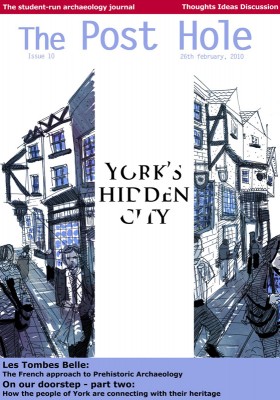
Hidden Cities is a new photography feature intended to take Post Hole readers through parts of famous cities that tourists, and perhaps even the residents, never get a chance to see. It is our earnest hope that this will expand the type of submissions we receive. The Post Hole team welcomes photographs of any city. We hope you enjoy the Hidden City of York.
Introduction
York is my home. This is where I choose to live. It is an understatement to say that York has a very rich past. However, no words come to mind when trying to describe the overwhelming sense of history that I experience every day. To keep true to our publication, I have chosen places with diverse pasts and which have been archaeologically examined. Among the photos, one will find a view of the Hungate site from the divided River Foss, along with Lady Peckitt’s Yard and a few gems from the often overlooked west bank of the city.

Figure 1 - As a student I cross this bridge often, but with all the hustle and bustle, it is easy for the hundreds of residences, which lie above or behind the storefronts to go unnoticed. The Blue Bicycle restaurant denotes a well-known landmark for many students and residents. (Credit: Author).

Figure 2 - This a panorama of Tower Place, a line of houses near the River Ouse.(Credit: Author).

Figure 3- A secret garden is enclosed by the city walls, a separate wall facing Peasholme Green, and the Quilt Museum. While the nearby Foss Islands road and Peasholme Green make the area a noisy retreat at times, watching the sunsets at different times of the year transform it into an unforgettable escape.(Credit: Author).

Figure 4-This is the old churchyard of St. Saviours, a redundant church now known as DIG, an archaeology showcase and hands on centre for the public.(Credit: Author).

Figure 5 - An alley leading off of the main Tower Place snickelway.(Credit: Author).

Figure 6 - To bring to an end this half of the Hidden City of York, I took a picture of the construction site at Hungate. In the image, we can see two symbols of York; past and present. On the far left is the Stonebow House, a modern building home to two alternative music venues. A little to the right and further back is the York Minster, a testament of the city’s long and beautiful history. In the foreground, archaeological investigation is delving into this past to understand the people who inhabited this city and created these out-of-sight gems.(Credit: Author).
This is the second part of the On Our Doorstep feature considering examples of how the people of York interact with their heritage. For the first part, on Raindale Mill, please see Issue 9.
York Georgian Society

Figure 1- Reproduced by kind permission of York Georgian Society.
The York Georgian Society (YGS) was formed in October 1939, its inaugural meeting taking place at the Mansion House on Wednesday 18th at 3:30pm (Buttery 1989, 2). Now in its 70th year, the Society has come a long way and, as the second oldest society outside London devoted to the Georgian era, is highly respected both locally and nationally for its expertise (York Georgian Society 2008-2010). This article will look at some examples of work and activities of the Society's earliest years and then look at where the Society is today.
The Society's first Chairman, Mr Oliver Sheldon, had earlier in 1939 been concerned about the timing of setting up a new society in York but by October had revised his opinion writing, "…the Society, despite the war - and, indeed in some measure, because of its possible ravages and deprivations - should begin its work as planned earlier" (Buttery 1989, 1-2). Sheldon outlined the object of the Society as
[Quote] "to take such steps as are possible to ensure the care and preservation of Georgian buildings in York and neighbourhood, and to strengthen and develop public interest in Georgian art and architecture… To preserve such buildings, or, where they must pass, to retain a permanent record of them, is a duty we owe both to the genius of a great past era in architecture and to the standards of architectural taste in the future." (Buttery 1989, 2) As will become apparent below, the wording of this has changed but its aim is essentially the same.
Sheldon, as a Director of Rowntrees, was a prominent figure in the city and this, combined with his talent as a campaigner, resulted in the Society having a good deal of support in high places (Buttery 1989, 2, 10). The first President of the Society was the Earl of Harewood (followed by the Princess Royal on his death) with the Lord Mayor of York, The Archbishop of York, The Viscount Halifax, The Earl of Feversham, Lord Derwent, Lord Middleton, The Countess of Chesterfield, Lady Grimthorpe, the Dean of York and the Member for York as Vice-Presidents (Buttery 1989, 2, 13).
One of the Society's first jobs was the assembly of a list of all Georgian buildings in the City and neighbourhood "which present points of interest" (Buttery 1989, 2). A copy of this was later given to the City Council, in accordance with the 1944 Town and Country Planning Act, with recommendations for 'listing' (Buttery 1989, 7). The purpose of this project was, however, originally to furnish the Society with a comprehensive list for its own use and interest rather than for the government (Buttery 1989, 7).
In its first example of giving practical advice, the Society helped the City Council in furnishing a Georgian room at the Castle Museum (Buttery 1989, 4). This was the first of many practical projects the Society has been involved in and was followed by that concerning the post-war restoration of the Shambles and the campaign to save Wentworth Woodhouse (Buttery 1989, 9). It was not until sometime later, however, that the Society was ready to take on greater challenges. One of the first of these was the restoration of the Georgian Assembly Rooms (now ASK restaurant) on Blake Street (Buttery 1989, 13).
Considered York's most important Georgian building, the Assembly Rooms were used as the Food Office during WWI and, urged by the Society, in 1949 the City Council decided to restore them (Buttery 1989, 13). The Society, consulted on this matter, recommended that the interior of the Rooms be designed in the Georgian style and "used for purposes befitting their dignity and interest" such as civic receptions and social functions (Buttery 1989, 13). The building was to be "the cultural, artistic and social centre of the City" under the control of the council through a Sub-Committee (Buttery 1989, 13-4). The Society was also heavily involved in the celebrations marking the official opening of the restored Rooms - a Georgian Ball held on 15th June 1951 (Buttery 1989, 14-5). It was an adventurous undertaking, not least because the war had left few people with money enough to restore such a building to its former glory. Donations were small but, as one wrote of his, "It is a slight offering, but one that carries my heart with it" (Buttery 1989, 14). The Society's annual report for that year proclaimed the Ball unforgettable; "we were living again in the 18th century in an age of gracious manners and leisured ease" (Buttery 1989, 16).

Figure 2- Lady Crathorne cutting the 70th anniversary celebration cake. Reproduced by kind permission of James Crathorne.
Despite the difficulties of the war the YGS prospered, thanks in no small part to Miss Pressly who succeeded Paul Crombie as Secretary when he left for active service (Buttery 1989, 1, 6). Miss Pressly's influence and hard work resulted in the Society's well-organised and highly informative visits (Buttery 1989, 6). On her retirement in 1961, after more than 20 years in the post, it was commented that Miss Pressly "has been the backbone of the Society, for without her devoted work…it is doubtful whether this Society would have carried on" (Buttery 1989, 26). The earliest of the Society's public lectures, now a permanent feature during the winter, was given by Mrs K. A. Esdaile on the subject of Georgian Sculpture (Buttery 1989, 6). Thus the "two mainstays of the Society's social and cultural activities" were born (Buttery 1989, 6).
The death of Oliver Sheldon on 7th August 1951 marked the end of the first phase of the Society's history (Buttery 1989, 16).
The year 2008/9 was one of both celebration and sadness for the Society. In August last year the Society celebrated the 70th anniversary of its foundation but sadly lost Lady Crathorne (Figure 2), the seventh President of the Society, 6 short weeks later (Green 2009, 5, 56). The first of two events held to mark this anniversary was an evening visit to view the monuments in the landscape of Castle Howard (Hutton 2009, 47). Guided by the Castle's Curator, Dr Christopher Ridgway, members of the Society made their way through the gardens to view the Mausoleum (Figure 3) before retiring to the Temple of the Four Winds, "an enchanting building" (Hutton 2009, 47, 49), for wine, canapés and cake. This visit, although celebratory in nature, is indicative of the informal but informative excursions of the Society's summer programme, built on the foundation of Miss Pressly's trips. A leisurely walk through the grounds of Bramham Park (Figure 4), viewing interior restoration work at Aske Hall and a private tour round Kiplin Hall are just a sample of the delights experienced by members during the summer of 2009 (see Freedman and Green 2009, pp. 32-52).

Figure 3: The Mausoleum at Castle Howard. Reproduced by kind permission of James Crathorne.
But the Society's remit does not just cover buildings and landscapes of the 18th century, as last winter's lecture programme is testament to. James Lomax, Curator of Temple Newsam House, spoke on the subject of Chinoiserie Silver in England from 1660 to 1830 and the 18th century painter Thomas Gainsborough was the subject of the lecture given by Hugh Belsey a Senior Research Fellow at the Paul Mellon Centre for Studies in British Art, London (see Freedman and Green 2009, pp. 11-31). The last lecture in this season's programme will take place at 2:30pm on Saturday 20th March at The National Centre of Early Music, St Mary's Church, Walmgate, York. It is given by Mark Newman of the National Trust on the subject: 'The Wonder of the North': The Designed Landscapes of Studley Royal.

Figure 4: The Round House, Bramham Park. Reproduced by kind permission of Richard Green.
These events, undoubtedly enjoyable, are only a part of what the Society does today. Working behind the scenes is a dedicated team of Historic Buildings Representatives who, although not consulted directly by the City of York Council, are part of the Council's Conservation Areas Advisory Panel (Sinclair 2009, 7). In consideration of the only planning application made during 2008/9 that concerned a building of Georgian date the Panel objected to the proposed demolition and replacement with flats over a hot food take-away (Sinclair 2009, 7). The building in question, "an unobtrusive little house in Cumberland Street" (Figure 5), was considered "perhaps the last example of the small-scale, unostentatious buildings" (Sinclair 2009, 7) which were once prolific in this area of the city. The Panel recommended that it should not be demolished and the Society suggested to the City Council that an interior inspection should be conducted, to ascertain the extent of surviving original features, followed by a possible referral to English Heritage for listing (Sinclair 2009, 7). The Society's Historic Buildings Representatives also worked on projects involving York Station, the Guy Fawkes Inn and the early Rowntree buildings (Sinclair 2009, 8). Sinclair notes also that, unfortunately, the Council will longer consult the Society on planning applications which fall within its aims and objectives (Sinclair 2009, 8-9). Despite this the Society has achieved a great deal to be part of the Conservation Areas Advisory Panel and will continue to "do the best [it] can and try to maintain a watch for any application which affects a specifically Georgian building" (Sinclair 2009, 8-9).

Figure 5: Cumberland street house. Reproduced by kind permission of Richard Green.
Perhaps the most significant occurrence for the Society during the 2008/9 year was the passing of its new constitution in December 2008 (Green 2009, 5). One of the important outcomes of this is that the scope of research the Society can support, through the Patrick Nuttgens Award, was widened beyond 'York and its neighbourhood' (Green 2009, 5). The Society's Constitution now reads "with special but not exclusive reference to the City of York and its neighbourhood" (York Georgian Society 2008, 1). The award, named after the architect, broadcaster and educationist Patrick Nuttgens who held the posts of Secretary, Chairman and President of the Society, is presented to a PhD student at the University of York during their second or third year of research into an aspect of the Georgian period (van Manen 2009, 54). The changes made allowed the Society to present the award to Niels van Manen to help him in his research into the social and medical history of chimney sweeps in late 18th and early 19th century Britain (Green 2009, 5). This award is given annually. The deadline for applications to this year's award is midday on Monday 1st March and included in the Appendix to this article is some information about applying. For further information contact the award's Co-ordinator Ann Rycraft at: rycraft992@btinternet.com.
As one would expect, much has changed in the 70 years since the foundation of the York Georgian Society. The Society has progressed from a small collection of enthusiasts making visits and hearing lectures to a group including experts, both amateur and professional, who hold a respected position in the City as possessing knowledge and skills of the utmost integrity. The Society has, and I am sure always will, work tirelessly in favour of all aspects of the culture of the 18th century, from art and architecture to objects and buildings.
For further information see the York Georgian Society website: www.yorkgeorgiansociety.org
Bibliography
- Freedman, E and Green, R (eds.) (2009) York Georgian Society 1939-2009: Annual Report 2009, York: York Georgian Society.
- Green, R (2009) 'Chairman's Report' in E Freedman and R Green (eds.) York Georgian Society 1939-2009: Annual Report 2009, York: York Georgian Society, pp. 5-6.
- Green, R (2009) 'Sylvia Mary Crathorne (1942-2009)' in E Freedman and R Green (eds.) York Georgian Society 1939-2009: Annual Report 2009, York: York Georgian Society, pp. 56-7.
- Hutton, A (2009) 'Visit to Castle Howard: Monuments in the Landscape' in E Freedman and R Green (eds.) York Georgian Society 1939-2009: Annual Report 2009, York: York Georgian Society, pp. 47-9.
- Sinclair, A (2009) 'Historic Buildings Representatives' Reports' in E Freedman and R Green (eds.) York Georgian Society 1939-2009: Annual Report 2009, York: York Georgian Society, pp. 7-9.
- van Manen, N (2009) 'The Patrick Nuttgens Award 2009' in E Freedman and R Green (eds.) York Georgian Society 1939-2009: Annual Report 2009, York: York Georgian Society, pp. 55-4.
- York Georgian Society (2008-2010) York Georgian Society website: www.yorkgeorgiansociety.org. Accessed Tuesday 16th February 2010.
Appendix
The Patrick Nuttgens Award 2010
The Patrick Nuttgens Award has been established to encourage research in aspects of eighteenth-century and early nineteenth-century history and culture. The Award is named in honour of the late Patrick Nuttgens, architect, broadcaster and educationist, who was founding Director of the Institute of Advanced Architectural Studies within the University of York and successively Secretary, Chairman and President of the York Georgian Society. One Award, of £500, will be made in 2010.
Eligibility
The Award is open to postgraduate students currently registered for the PhD degree at the University of York, in their second or third year of study (or part-time equivalent), who are researching aspects of the Georgian period.
The scope of the Award extends to any study of Georgian architecture, arts, culture and society. Students may be registered for the PhD on a full-time or a part-time basis. Students may not receive the Award more than once.
The award may be used for any legitimate research expenses, such as travel to archives, libraries and museums, attendance at conferences, and the purchase of books, photographs, or other research materials, etc. The award may not be used for general subsistence, tuition fees or the purchase of equipment.
Applications for the Award will be judged according to the following criteria: a) the originality of the research project, b) the nature of the research expenditure proposed and its value in developing the project, and c) financial need.
How to apply
Applications should be sent as an email containing two attachments (see below), by midday on the closing date of 1st March 2010, to the Patrick Nuttgens Award Co-ordinator, Ann Rycraft, at rycraft992@btinternet.com.
The required attachments, each including the applicants name in the file title, are as follows:
- A letter of application, addressed to the Patrick Nuttgens Award Sub-committee, which should include a one-page description of the project, together with an indication of the stage of completion currently reached. In this letter, applicants should explain the specific purpose or purposes for which the award would be used, and provide as detailed as possible an estimate of costs. Applicants are requested to indicate whether or not they are currently in receipt of funding in the form of scholarships or other awards.
- A curriculum vitae, including the name and contact details of one referee, who should normally be the student's academic supervisor. It is the responsibility of the applicant to ask the referee to write a confidential recommendation and to ensure that this reference is delivered in a sealed envelope to the Patrick Nuttgens Award Co-ordinator, York Georgian Society, c/o The Merchant Adventurers' Hall, Fossgate, York YO1 9XD, by the closing date.
Selection
Applications will be scrutinised by a Sub-committee of the York Georgian Society, and applicants will be notified of the result by 6 March 2010. The deliberations of the Sub-committee will be confidential and will not be communicated to applicants or the public, with the following exceptions:
- The Sub-committee will announce the name of the Award winner, together with details of his or her research project
- The Sub-committee may nominate applications considered by its members to be of special merit in addition to that of the Award winner.
The decision or decisions of the Sub-committee will be final.
Conditions of acceptance
The successful applicant will be required to provide a short report on the use of the Award, to be sent by email to the Patrick Nuttgens Award Co-ordinator, Ann Rycraft, at rycraft992@btinternet.com by 30 September 2010. The recipient of the Award might also be asked to give a presentation to the Society.
An interview with Professor Martin Carver, conducted by Mark Simpson- 17/02/10
If you ask an archaeologist, or even an archaeology student, to name a legend of the profession, you may well get a number of different answers. Gordon Childe, Graham Clarke, C.J. Thomsen, Colin Renfrew, even Indiana Jones are likely to be among the names that come up. But ask the same question in the York archaeological community and one name will keep occuring: Emeritus Professor Martin Carver.
Former army officer, ten years as head of department at York, editor of Antiquity, excavator at Sutton Hoo (and many other sites around the world), Professor Carver is much respected and loved by both current and former students and staff of the Department. He has a new book, Archaeological Investigation (Figure 1), available and I was able to interview him at the launch, held recently at King's Manor…

Martin Carver's new book. Reproduced by kind permission of Martin Carver.
Mark Simpson - We are here today for the launch of your new book, Archaeological Investigation. Could you tell me a little about the book please?
Martin Carver - It's a book for first years - pretty much based on the course at York I've given since 1987 and it's been developing through that time, thanks to our first years. Every year they've brought new questions and new ideas, which has helped enormously. I was originally commissioned to write a book on Field Archaeology for Thames and Hudson, a bit like another Renfrew and Bahn book, with an American co-author. I spent fourteen years on it and the book grew to 450,000 words and they said 'We can't publish this!' So I said well, fine, and I started again and I split it into two. The book that has come out today, thanks to Routledge, is meant for undergraduates, school leavers and so on, and its objective is to bring together the academy, that's the people who do research in universities, and the profession, that's the people who do research using developer's money. All my life I've felt that these two groups should be working together, and have a single objective and a single mission. Only a few of our students who leave university become lecturers, but very many of them do go and work in the profession. So what I'm hoping to provide is something that will become an old friend, when you're working in the trenches, looking for sections to draw for the developers. Something to tell you that you're part of a much bigger operation. We're all in it together, we're all trying to find out about the past, we're not just trying to hold down a job.
The first three chapters give you the principles, next comes a section on being in the field, then on how to write up reports and finally on how to design projects. So it's the sort of book you could grow up with, the first bit is very much what we teach in university, then you go into the field and find out what it's really like, then the third bit is about when you get more responsibility: you're writing up and reporting on what you find. But I think the last bit, project design, for me, is the key skill and it's changing archaeology. We're becoming more like architects, and less like building labourers, that's what project design is doing.
Mark Simpson - At the moment, First year students at York are grappling with archaeological theory. Can you tell us what your theoretical position is?
Martin Carver - I'm very interested in theory, and regard it as a big toolbox, with lots of ideas in it. And I'm very impressed with how all those ideas can remain valid. The trouble with theory is that there is a lot of kudos attached to it. So everyone is looking for the 'latest theory' on the understanding that it might supplant the one before. But my feeling is that a lot of people out there are still interested in getting the cultural sequence right, others are still interested in studying process, while others are more interested in studying symbolism. So although it is quite hard to be all those things, and be reflexive on top of that, you have to try. It's like you can't really be a novelist with only one plot, or a musician who writes for only one instrument.
I do feel that sometimes theory gets a bit narrow, because it wants to 'score points' and be the theory that is driving archaeology at the moment; whereas actually it's a game we all play and it's all to do with interpretation, to do with deciding what you've got and what it means. In the field I know everyone wants to separate data from interpretation. Before Ian Hodder made it, quite rightly, a main part of archaeology to merge observation and interpretation, we were long doing this in my type of field archaeology, the sort you'll find in the book. Readers will notice that it doesn't just go down the old line of single context recording and matrixes; those will be seen as useful tools, rather than gospel. I take the view that on site you are always interpreting, recording your observations and recording your interpretations and one builds the other. Say you take a group of people who are digging and talking about what is happening on the dig, either afterwards at the pub or in a break. You soon get the feeling that there is always a consensus at a certain level. Everyone will agree that they're in Yorkshire, and agrees that this is some kind of Roman building, but they may not agree on what sort of building it is. The interpretations will then rise to higher levels. 'It's a villa', then at a higher level, 'it's a high status villa'. Then, 'it belonged to Carausius'. Then at a higher level still, 'this is a tower in the middle', followed by 'in the tower is a hook where Carausius hangs his hat'. For me, interpretation is this tower of invention, getting more and more lofty, and losing more people the higher it goes, but if you don't like where you are, you just go back down to the previous level you did believe in.
It's not going to be black and white, when you do archaeology. Sometimes as a first year you think, 'I don't think much of this as a science, there seem to be no facts in it!' But that's like life. That's what I think about theory, I love it, but for me it is at the service of archaeological investigation, not the other way around.
Mark Simpson - What would you say is the most significant find you have made in your archaeological career?
Martin Carver - Well, that's a hard question because it mixes up what is significant to other people with what is significant to me. What's significant to me was taking the brick floor off the bottom of the old theatre in Durham in 1974 and smelling this incredible smell of vivianite, preserved wood and debris, and underneath this, just literally inches under the floor, finding a preserved 10th century house, alongside the street, at the very beginning of the life of Durham. Every day we were pulling out pieces of textile and silver birch posts, with the bark still on. Amazing. That gave me such a thrill, because it was very unexpected as well.
I suppose if I had to step aside and say what is the most significant thing for other people, or what it ought to be, it was finding the Pictish monastery at Portmahomack, because there weren't any Pictish monasteries before we found that one. In fact a lot of people didn't think there were any Pictish churches. I think that scored quite a hit. We were quite surprised because we thought we were going to dig a settlement. In a way it was quite annoying! But pretty good for people studying that period.
Mark Simpson - Do you have any projects currently underway?
Martin Carver - My main job is editing Antiquity, which is pretty much full time - but as for projects, I've now written up all my own stuff, but still love writing. The last project to go was Stafford, which has just been completed and is going to press this month - it should come out at the end of this year, so then my backlog is finished. What I've started to do as my retired job is to write up other people's excavations, where they've died or got no time. I've just got the go-ahead to do Pitcarmick, a beautiful site in Perthshire dug by Jane Downes and John Barrett. It's got the only convincing Pictish houses on the mainland, but it also has Bronze Age and Iron Age buildings, a really nice landscape sequence.
Why would I do that? Well, it's a good question. I did think of going to Sicily and doing a big excavation there, I had opportunities in Italy, and in France, I could have dug in Scandinavia, and Yorkshire as well. And it still may happen, but for me it can only happen if there's enough money to do it professionally. I don't want to be a sad retired person, with a spade, digging an untidy hole somewhere. So I work very closely with FAS (Field Archaeology Specialists) Heritage here in York, the second field company I've founded, and I'm also going to work again with my first company Birmingham Archaeology at Stratford Upon Avon, where they are doing a project at Shakespeare's New Place.
At this stage of life I want to leave the digging to young people, who have better eyes and are happy to fill a barrow all day long, all the things I used to do. Now I like to do what I'm better at than them: writing up, or designing new projects.
Mark Simpson - If you were offered a trip in a time machine, which historical period would you visit?
Martin Carver - Oh, the 7th Century! I've spent most of my life mentally in the 7th century, and I'll tell you why. In northern Europe, and other places too like north Africa, where I've worked, it was a period of political freedom, so there was no overarching authority, trying to make people act and think exclusively in one way. For that reason it liberated the ideas that are present inside people and which can come out they're not all dragooned into all doing the same thing. If you take a piece of rough ground which is dominated by bracken and turf, if you mow that off and leave it, in the spring a thousand flowers come up, all sorts of things come up, because they are no longer inhibited by the bracken. And that's what happened in the 7th Century, in Europe and Africa.
The big new ideas, Islam and also Christianity, were certainly on the horizon, but before they got there, there was a chance for people to express themselves freely. And that's why this period has such an amazing diversity of monuments. Archaeologists and art historians used to translate this as 'oh dear, they didn't quite know what they were doing, they were waiting for the Christians to come and show them how to do it'. But my own researches suggest that all these people who lived in England, Scotland and Ireland, Scandinavia, the Rhineland and so on, they were receiving these new ideas and then making them into special statements of their own. That's where the special monuments come from. So you've got this immense European anthology of ideas which later got lost in the undergrowth. You can find them popping up from time to time, as heresies or little rebellions, other ways of living, other ways of thinking about the next world. The 7th Century is the last time we can see them all clearly.
Professor Carver, thank you for your time.